
Every ETP and STP produces sludge — it’s an unavoidable byproduct of the biological and chemical treatment processes that remove pollutants from wastewater. Yet sludge management is the most consistently overlooked aspect of industrial water treatment compliance in India. Facilities invest lakhs in building a proper ETP, ensure effluent quality is monitored, renew their CTO — and then dump the generated sludge in an unsecured corner of the plant or hand it to a contractor who disposes of it informally.
This is not just bad practice — it’s a criminal liability.
Understanding Industrial Sludge — What Is It and Where Does It Come From?
ETP sludge is the concentrated solid residue separated from wastewater during treatment. It comes from:
- Biological sludge: Dead and living microorganism biomass from MBBR/SBR aeration tanks, settled in the secondary clarifier
- Chemical sludge: Precipitated solids from coagulation/flocculation (alum, ferric chloride treatment), heavy metal hydroxide precipitates from pH treatment
- Primary sludge: Settled suspended solids from initial clarification
STP sludge (from housing society and commercial STPs) is primarily biological — less chemically complex than industrial ETP sludge but still requires proper management.
The critical question for any industrial facility: Is our sludge classified as Hazardous Waste?
Hazardous Waste Classification — The Most Important Sludge Decision
Under the Hazardous Waste (Management, Handling and Transboundary Movement) Rules, 2016 and Schedule I/II/III of the rules, certain industrial ETP sludges are classified as hazardous waste and must be managed accordingly.
Sludge likely classified as Hazardous:
- ETP sludge from electroplating and metal finishing (Category 16.1 — cyanide/heavy metal content)
- Chemical ETP sludge containing heavy metals (chromium, lead, mercury, arsenic above threshold limits)
- Pharmaceutical ETP sludge from API manufacturing
- Textile ETP sludge with dye compound concentration above threshold limits
- Sludge from treatment of effluent containing Schedule I or II hazardous chemicals
Sludge typically NOT classified as Hazardous:
- STP sludge from residential/commercial sewage
- ETP sludge from food processing (purely organic, no hazardous compounds)
- ETP sludge from general manufacturing without chemical hazards
The test: conduct TCLP (Toxicity Characteristic Leaching Procedure) analysis or refer to Schedule I/II of the HWM Rules for your specific industry. Your SPCB consent conditions may also specify the classification for your category.
CPCB/SPCB Penalties for Improper Sludge Disposal
Improper disposal of hazardous sludge — dumping on open land, giving to informal scrap dealers, unmanifested transport — constitutes a violation of the HWM Rules and Environment Protection Act:
- Imprisonment: Up to 5 years under EPA 1986 for first offence
- Fine: ₹1 lakh per day of continuing violation
- NGT penalties: National Green Tribunal has ordered penalties ranging from ₹5 lakhs to several crores for industrial units found disposing hazardous sludge illegally
- Factory licence suspension: Pollution non-compliance can trigger factory licence suspension under the Factories Act in addition to environmental penalties
- Criminal liability: Unlike most compliance violations that result in regulatory action, illegal hazardous waste disposal can result in personal criminal liability for the responsible person at the facility
The critical implication: improper sludge disposal is not just an environmental compliance issue — it’s a personal liability issue for EHS managers and facility heads.
Sludge Treatment — Reducing Volume Before Disposal
Raw sludge from clarifiers typically has 95–98% water content (2–5% dry solids). Transporting and disposing of this as-is is extremely expensive — you’re paying to transport mostly water. Sludge dewatering reduces volume and disposal cost:
Filter Press (Most Common in India)
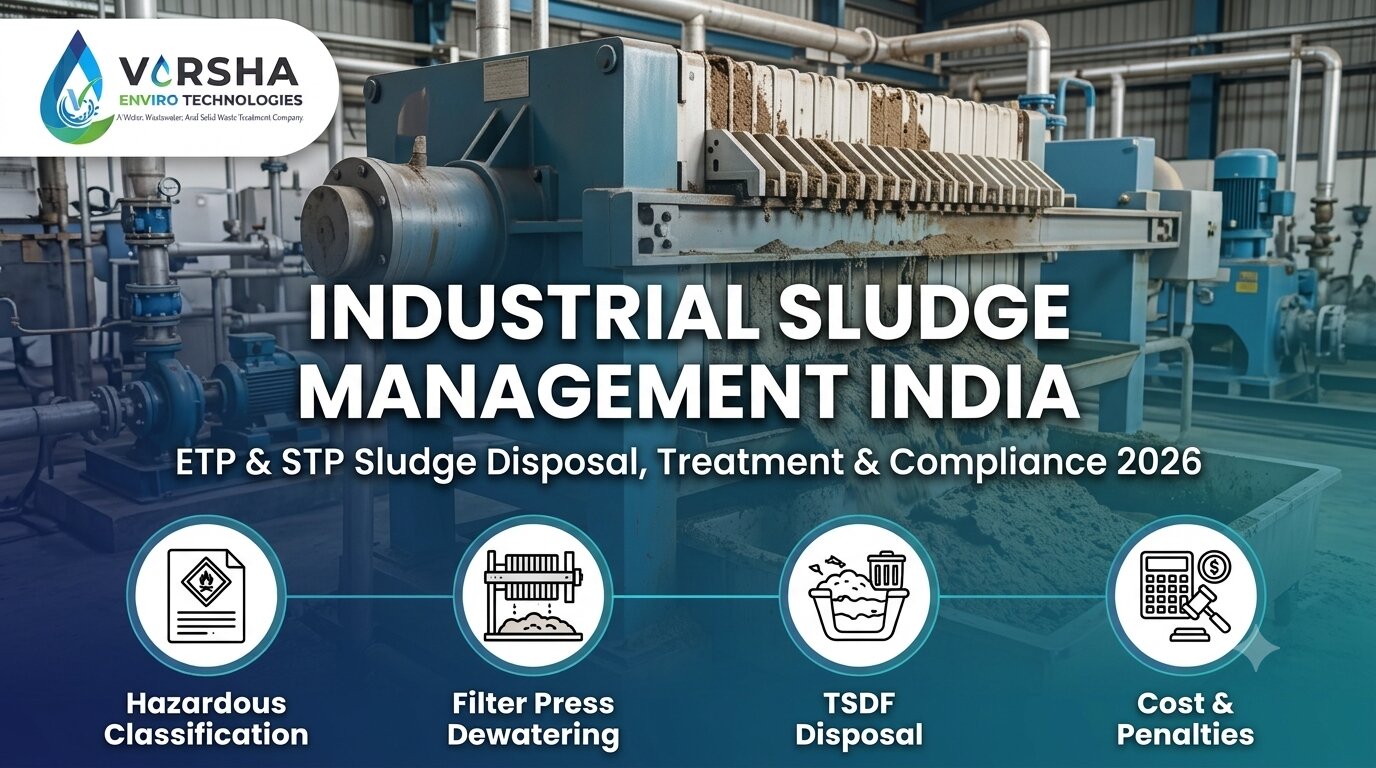
A filter press applies mechanical pressure to sludge, forcing water through filter cloths and producing a “sludge cake” with 20–35% dry solids (vs 2–5% in raw sludge). Volume reduction: 10–20×. This dramatically reduces transportation and disposal cost.
Filter press cost: ₹2 – 15 lakhs depending on plate area and automation level. Operating cycle: Batch process — fill chambers, press (15–60 minutes at 6–15 bar pressure), open plates, discharge cake.
Centrifuge Decanter
Continuous process — sludge is fed continuously, centrifugal force separates solids. Output: 18–25% dry solids. Higher throughput than filter press for large-volume sludge. More expensive to purchase (₹10–40 lakhs) but lower labour per tonne of sludge treated.
Preferred for large industrial ETPs generating >500 kg/day dry sludge.
Sludge Drying Beds (Low-Cost Alternative for Non-Hazardous Sludge)
For non-hazardous STP sludge, sludge drying beds — shallow gravel-filled beds where sludge is spread and dried by sun and drainage — are a low-cost dewatering method. Output: 20–40% dry solids depending on climate and exposure time.
Not appropriate for hazardous ETP sludge that requires controlled handling.
Sludge Disposal Options — Hazardous vs Non-Hazardous
For Hazardous ETP Sludge
TSDF (Treatment, Storage and Disposal Facility) disposal: The only legally compliant route for hazardous ETP sludge in India. TSDF facilities are licensed by SPCBs to receive, treat, and permanently dispose of hazardous waste. Key points:
- Every hazardous sludge movement must be accompanied by a Form 10 Manifest (waste transport document) signed by generator, transporter, and receiving TSDF
- SPCB registration of the TSDF must be verified before engagement
- Annual returns to SPCB on hazardous waste generated and disposed must be maintained
TSDF disposal cost (India, 2026): ₹5,000 – 25,000 per MT depending on TSDF location, sludge category, and volume. Transportation to TSDF is additional cost.
For industries in Haryana, TSDF facilities in the Bhiwadi-Alwar belt and Jhajjar area serve the region. In Rajasthan, RIICO-authorized TSDFs accept hazardous industrial waste.
For Non-Hazardous STP/ETP Sludge
Non-hazardous biological sludge from residential STPs and food processing ETPs (after TCLP testing confirms non-hazardous classification) has several legitimate disposal/use options:
1. Agricultural land application (compost): Well-stabilized, non-hazardous biological sludge with acceptable heavy metal levels can be applied as a soil amendment. Requires testing for heavy metals, pathogens, and nutrient content. State agricultural department approval may be needed.
2. Landfill disposal: Municipal solid waste landfills may accept non-hazardous dried sludge as solid waste — confirm with local municipal authority.
3. Brick/cement co-processing: Some cement plants and brick manufacturers accept dried non-hazardous sludge as a raw material substitute — reducing disposal cost to near-zero in some cases.
Sludge Management Compliance Documentation
Regardless of sludge classification, maintain:
- Monthly sludge generation log (volume/weight generated, dewatered, stored, disposed)
- Manifests/receipts for every sludge removal movement (Form 10 for hazardous, disposal receipts for non-hazardous)
- Annual returns to SPCB (mandatory for hazardous waste generators)
- TCLP test report confirming hazardous/non-hazardous classification (update annually or when production processes change)
These records are reviewed during SPCB inspections and CTO renewal — missing documentation is a common inspection finding.
Varsha Enviro’s repair and maintenance services and operation and maintenance services include sludge management protocols and documentation support as part of our AMC scope for industrial ETP/STP clients.
Practical Cost Planning for Industrial Sludge Management
For a 100 KLD industrial ETP (typical mid-size manufacturing unit):
- Sludge generation (raw): Approximately 2,000–5,000 litres/day (depending on treatment stages and effluent load)
- After filter press (20% DS): Approximately 50–250 kg/day sludge cake
- Monthly TSDF disposal (hazardous, ₹12,000/MT average): ₹18,000–90,000/month depending on sludge generation rate
- Filter press operation + labour: ₹10,000–20,000/month
- TCLP testing (annual): ₹5,000–15,000
Total monthly sludge management cost range: ₹30,000–1,10,000/month for a 100 KLD industrial ETP with hazardous classification. Non-hazardous sludge (food processing, residential) is significantly cheaper — landfill or compost disposal at ₹500–2,000/MT.
Frequently Asked Questions
Q: How do I know if my ETP sludge is hazardous? A: Refer to Schedule I, II, and III of the HWM Rules 2016 for your industry category. If your industry is listed under categories generating hazardous waste, your ETP sludge is likely classified as hazardous. Confirm with a TCLP test from a NABL-accredited lab — this test is the definitive classification tool.
Q: Can we store sludge on-site temporarily? A: Yes — HWM Rules allow temporary on-site storage for up to 90 days in a designated hazardous waste storage area (properly constructed, labelled, with secondary containment). Beyond 90 days without disposal is a violation.
Q: Is there any value in ETP sludge — can it be sold? A: For certain industries, sludge has commercial value: metal-rich sludge from electroplating may be accepted by metal recovery facilities; dried non-hazardous biological sludge from food/organic industries has agricultural value as compost. Some cement plants co-process high-calorific sludge as alternative fuel. Whether your sludge has value depends on its composition — testing identifies recovery opportunities.
Q: Our STP sludge — does it need TSDF disposal? A: Typically no for residential/commercial STP sludge (purely biological, non-hazardous). Well-stabilized, dried STP sludge can usually be disposed as solid waste or used as compost without TSDF requirements. However, confirm with a TCLP test and your local SPCB before making disposal arrangements.
Final Thoughts
Sludge management is the compliance gap that gets facilities in trouble most often — not because they don’t know it matters, but because the “solution” is cheaper when done informally. The formal route (filter press + TSDF + manifests + annual returns) costs money, but the informal route creates criminal liability and NGT enforcement exposure that can cost far more. Getting your sludge classified, dewatering it to reduce disposal cost, and engaging a licensed TSDF is the right foundation for sustainable ETP/STP operation. Contact Varsha Enviro for sludge management guidance and AMC support that includes documentation for compliance.