
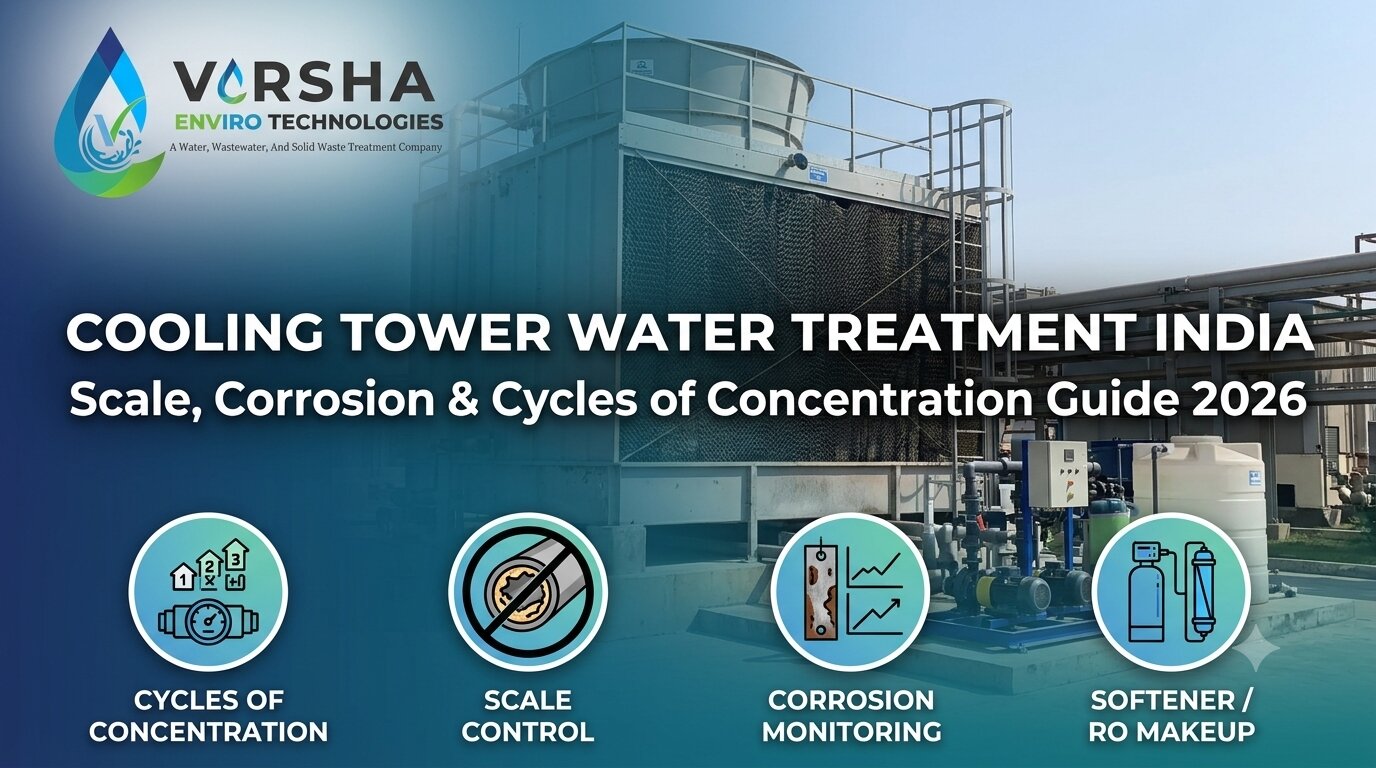
A cooling tower can run for years and still lose capacity every month. The reason is simple: a cooling tower works by evaporating water, and evaporation takes away only pure water. Every mineral, chloride, and microbe in the makeup water stays behind and concentrates in the basin. Left unmanaged, that concentrated water either deposits scale inside your condenser tubes or corrodes the metal around them, and nobody connects the rising chiller electricity bill to the water chemistry.
In North and West India, where borewell water is hard and high in TDS, this problem arrives faster than most facility teams expect. This guide explains how cooling tower water treatment actually works, the numbers worth tracking, and how pre-treating makeup water changes the economics.
The Three Threats Inside Every Cooling Tower
1. Scale: Calcium, magnesium, alkalinity, and silica cross their solubility limit as water concentrates and precipitate on the hottest surfaces, which are the heat exchanger and condenser tubes. Scale insulates the tube, so the chiller works harder for the same cooling.
2. Corrosion: Warm, oxygen-rich, mineral-laden water attacks bare metal. Corrosion pits tubes, and deposits trap moisture against the metal and accelerate the damage underneath.
3. Biological growth: The basin is warm, nutrient-rich, and exposed to airborne dust and microbes. Slime builds up on the fill, and stagnant, scaled areas can harbour bacteria such as Legionella. Biocide dosing is a health control as much as an efficiency one.
Cycles of Concentration: The Number That Controls Everything
Cycles of concentration (COC) is the ratio of dissolved solids in the circulating water to dissolved solids in the makeup water. A tower running at 4 cycles carries water four times more concentrated than what is coming in.
A practical way to measure it is by conductivity: if makeup water reads 300 µS/cm and tower water is held at 1,200 µS/cm, you are running at 4 cycles.
The blowdown math (simplified, ignoring drift):
- Blowdown = Evaporation ÷ (COC − 1)
- Makeup = Evaporation × COC ÷ (COC − 1)
Worked example, a tower evaporating 10 m³/hour:
| Cycles | Blowdown (m³/h) | Makeup (m³/h) | Makeup vs 3 cycles |
|---|---|---|---|
| 2 | 10.0 | 20.0 | +33% |
| 3 | 5.0 | 15.0 | baseline |
| 4 | 3.3 | 13.3 | about 11% lower |
| 5 | 2.5 | 12.5 | about 17% lower |
| 6 | 2.0 | 12.0 | 20% lower |
Two lessons sit in this table. First, moving from 2 or 3 cycles up to 4 saves a lot of water. Second, the returns flatten quickly: going from 5 to 6 cycles saves only 0.5 m³/h. Chasing very high cycles with a weak treatment programme just trades a water bill for a scaling problem.
Why Hard Borewell Water Limits Your Cycles
The maximum safe cycles for your tower is set by whichever limit you hit first: calcium and alkalinity, silica, or chlorides if you have stainless steel or sensitive alloys. Raw hard water often caps a tower at roughly 2 to 4 cycles, while softened or RO-treated makeup water can support more.
For facilities in Gurugram, Faridabad, Jaipur, Bhiwadi, and similar areas where borewell TDS commonly runs from 500 ppm to well above 1,000 ppm, this is where makeup treatment pays for itself:
- A water softener plant removes calcium and magnesium from makeup water, which directly raises the cycles you can safely run
- An RO plant cuts TDS as well, allowing the highest cycles and the lowest blowdown, at a higher treatment cost per litre
- For a closer look at what hardness does to equipment, see our guide to hard water problems in India
The right choice depends on your makeup water analysis, your tower size, and what blowdown and fresh water cost you. A water test is always the first step.
Monitoring Ranges Worth Tracking
A good programme is controlled by numbers, not by habit. Typical monitored ranges used across the industry:
| Parameter | Typical target | Why it matters |
|---|---|---|
| Cycles of concentration | 3 to 6 | Water and chemical economy versus scaling limit |
| pH | 7.5 to 9.0 | Balances corrosion against scale |
| Mild steel corrosion rate | Below about 5 mpy (lower is better) | Confirms the inhibitor film is working |
| Free oxidising biocide residual | 0.2 to 1.0 mg/L | Suppresses biofilm |
Your chemical supplier or water treatment partner should set exact targets for your system, since these depend on metallurgy and makeup water chemistry. Corrosion coupons, which are small metal samples exposed in the loop and weighed periodically, are the standard way to verify the inhibitor is actually protecting your equipment.
The Chemical Programme in Plain Terms
Treatment chemistry sits on top of good makeup water, not in place of it:
- Scale inhibitors (antiscalants): Keep calcium and magnesium in solution at higher concentration so they do not deposit on tubes
- Corrosion inhibitors: Form a protective film on metal surfaces
- Biocides: Typically an oxidising biocide plus a periodic non-oxidising shock dose, rotated to prevent resistant growth
- pH control: Often through acid dosing in hard water systems to limit scaling
Two practical points. Manual batch dosing causes swings between scaling and corrosion conditions, so automatic dosing linked to a conductivity controller is far more stable. And a conductivity-controlled automatic blowdown valve holds your cycles steady instead of leaving blowdown to whoever happens to open the valve.
What Untreated Cooling Water Really Costs
You rarely see the cost as a single line item, which is why it gets ignored. It shows up as:
- A chiller or condenser running at higher approach temperature and drawing more power
- Heat exchanger tubes cleaned or replaced earlier than planned
- Fill media replaced prematurely
- Higher makeup water and sewer or tanker costs from running too few cycles
- Biological risk in scaled, stagnant sections
Industry sources report that cooling water corrosion contributes to a large share of heat exchanger failures, and that even a thin scale layer measurably raises energy use. The takeaway for planning: the cost of a proper makeup treatment and dosing programme is usually small next to the combined cost of these effects.
Cooling Tower Treatment vs Boiler Water Treatment
These are often confused. A boiler needs far purer feed water because it concentrates water under high temperature and pressure. A cooling tower tolerates a higher mineral load but needs continuous scale, corrosion, and biological control. If you run both, you will likely treat them as two separate programmes. For the boiler side, see our guide to boiler feed water treatment in India, and for high-purity needs, a DM plant.
Varsha Enviro’s water treatment solutions cover softener and RO systems for cooling tower makeup across Delhi NCR, Haryana, and Jaipur.
Frequently Asked Questions
Q: What are the ideal cycles of concentration for a cooling tower? A: Most towers run between 3 and 6 cycles. The right figure depends on your makeup water chemistry and your treatment programme. Above 5 to 6 cycles the water savings shrink while scaling and corrosion risk rise, unless makeup water is softened or RO-treated.
Q: Can I treat only the circulating water and ignore makeup water quality? A: You can, but the treatment burden is much higher. Poor makeup water forces low cycles and heavy chemical use. Improving makeup water quality is often the most economical lever on both water and chemical cost.
Q: Why does my cooling tower keep scaling even though we dose chemicals? A: Common causes are running more cycles than the water chemistry allows, inconsistent manual dosing, a dosing pump that has failed unnoticed, or makeup water hardness that has risen with the seasons. A full water analysis plus a review of your blowdown control usually finds the cause.
Q: Does the cooling tower need biocide even if the water looks clear? A: Yes. Clear water can still carry biofilm and bacteria. Biocide control is a standard part of any programme, particularly for towers serving buildings with occupants nearby.
Q: How often should cooling tower water be tested? A: Conductivity and pH are checked daily or continuously with a controller, while hardness, alkalinity, chloride, microbial counts, and corrosion coupons are checked on a scheduled basis set by your treatment partner.
Final Thoughts
Cooling tower water treatment is not about adding more chemicals. It is about understanding your makeup water, setting cycles your chemistry can actually hold, and controlling the loop with measured numbers. In hard-water regions like Haryana and Rajasthan, treating the makeup water is usually where the biggest and most durable gains sit. Contact Varsha Enviro for a water analysis and a makeup treatment recommendation for your cooling system.