
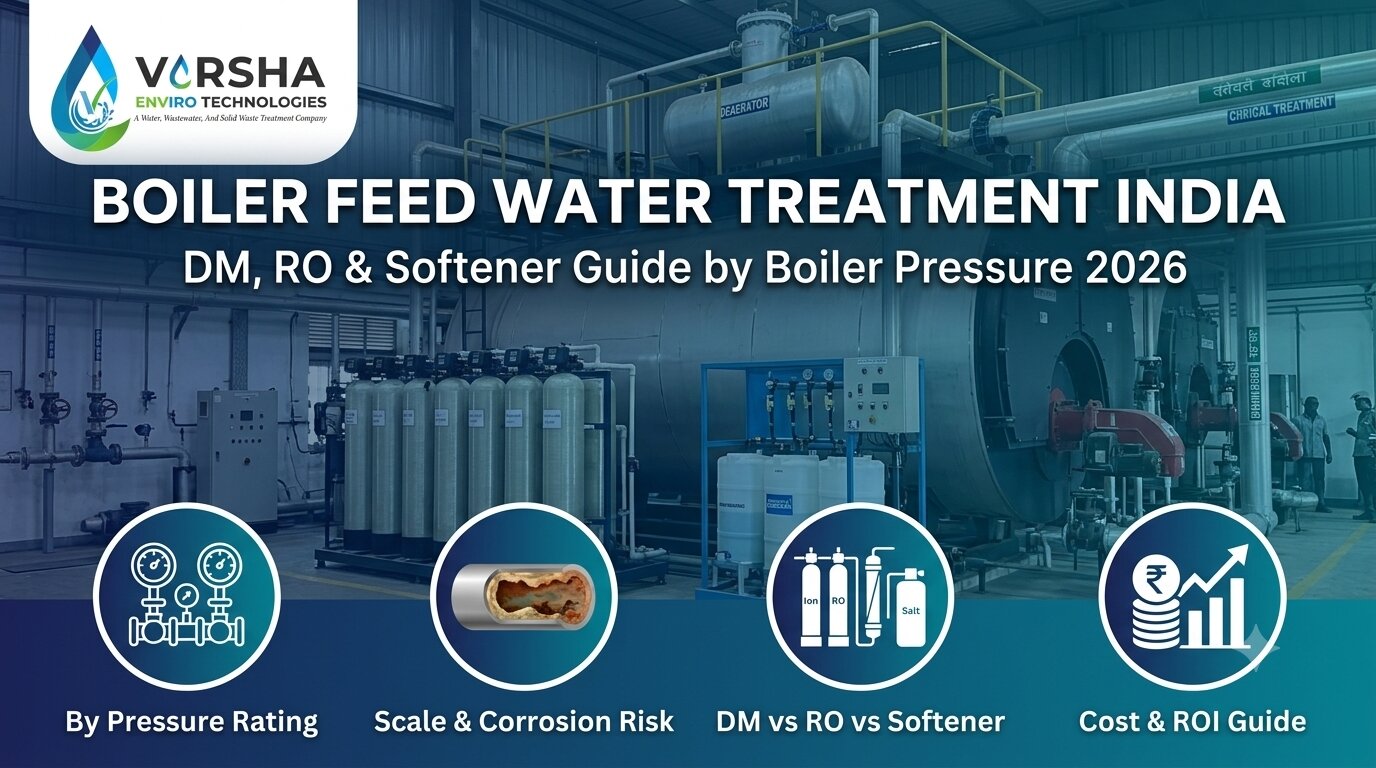
A boiler’s operational life, fuel efficiency, and safety are determined largely by the quality of its feed water. Yet water treatment remains one of the most commonly deferred capital expenditures in Indian industrial facilities — until a tube failure, insurance claim, or energy bill increase forces the issue. This guide explains what water treatment is required by boiler pressure rating, what happens when it’s inadequate, and which technology combination makes sense for your application.
Why Boiler Feed Water Treatment Is Not Optional
Scale inside boiler tubes is not just an efficiency problem — it’s a safety hazard. At sufficient thickness, scale acts as a thermal barrier that prevents the tube wall from conducting heat away from the combustion side. The tube metal temperature rises above design limits, eventually causing tube overheating, blistering, and rupture. This is a pressure vessel failure — not a routine maintenance event.
The scale-efficiency relationship (industry data):
- 1 mm of calcium carbonate scale → approximately 7–10% increase in fuel consumption
- 3 mm of scale → 25–30% higher fuel cost for the same steam output
- 6 mm of scale → 40–50% higher fuel cost + significant tube failure risk
For a medium-sized textile or food processing boiler consuming 500 kg of coal per day, a 3mm scale buildup translates to ₹8–15 lakh in additional annual fuel cost. The treatment plant that prevents it costs a fraction of that.
Boiler Feed Water Quality Requirements by Pressure
The required water purity increases with boiler operating pressure. BIS and IBR (Indian Boiler Regulations) specify feed water quality parameters:
| Boiler Pressure | Total Hardness | TDS | pH | Treatment Required |
|---|---|---|---|---|
| Low pressure (< 10 kg/cm²) | ≤50 mg/L | ≤500 mg/L | 8.5–9.0 | Water softener + pH correction |
| Medium pressure (10–20 kg/cm²) | Nil (0) | ≤300 mg/L | 8.5–9.0 | Softener + DM plant (partial) |
| Medium-high pressure (20–40 kg/cm²) | Nil (0) | ≤100 mg/L | 9.0–9.5 | Full DM water + deaeration |
| High pressure (40–100 kg/cm²) | Nil (0) | ≤5 mg/L | 9.0–9.5 | Full DM + deaeration + chemical dosing |
| Very high pressure / power plant (>100 kg/cm²) | Nil (0) | <0.1 mg/L | 9.0–9.5 | Full DM + mixed bed polish + deaeration |
Silica — the critical parameter for medium and high pressure boilers: Silica (SiO₂) forms extremely hard, glassy scale that is very difficult to remove chemically. In high-pressure boilers and steam turbines, silica can carry over with steam and deposit on turbine blades, causing efficiency loss and imbalance. BIS specifies silica limits: <5 mg/L for medium pressure, <0.02 mg/L for very high pressure boilers. Standard softeners do not remove silica — DM treatment is required.
Treatment Technology Selection by Boiler Type
Low Pressure Boilers (<10 kg/cm²)
These are the most common boiler type in small Indian industries — textile units, food processing, laundries, small chemical units. A water softener plant is the minimum requirement:
- Removes all calcium and magnesium hardness (prevents scale)
- pH correction with alkali dosing (prevents corrosion)
- Blowdown control to manage TDS buildup in boiler water
Cost: ₹30,000–2 lakhs for the softener unit depending on flow rate.
This combination is adequate for low-pressure boilers on reasonably good quality source water (TDS below 500 ppm). If source water TDS is high (above 500 ppm, common in Haryana/Rajasthan borewell sources), blowdown rate increases significantly — making partial DM treatment or an RO plant pre-treatment economically worthwhile to reduce feed water TDS.
Medium Pressure Boilers (10–40 kg/cm²)
These are standard in mid-size textile, pharmaceutical, food processing, and chemical plants. At these pressures, a softener alone is not sufficient — TDS and silica limits are stricter than a softener can achieve. Treatment requirement:
Recommended train: Raw water → Multimedia filter → Softener (hardness removal) → DM Plant (TDS and silica reduction) → Deaerator (oxygen removal) → Boiler
The DM plant at medium pressure is typically a two-bed system (cation + anion units) — producing conductivity of 0.5–5 µS/cm suitable for boilers up to 40 kg/cm². For boilers at the higher end of this range (30–40 kg/cm²), a mixed-bed polishing stage is added.
Deaeration: Dissolved oxygen causes corrosion in boiler tubes and feed pipelines — electrochemical pitting that can perforate tubes within years. Deaeration (mechanical degassing + chemical oxygen scavenging) is standard practice at medium pressure and above.
Cost: Full two-bed DM system for medium pressure boiler — ₹2–15 lakhs depending on capacity.
High Pressure Boilers (>40 kg/cm²)
Found in large chemical plants, pharmaceutical campuses, and power generation. At these pressures, water purity requirements approach those of pharmaceutical processes. Treatment:
Full train: Raw water → Clarification → Multimedia filtration → RO (primary TDS reduction) → Two-bed DM → Mixed-bed polishing → Deaeration → Chemical dosing (oxygen scavenger, phosphate, pH correction) → Boiler
RO at this stage: Used not for drinking water reasons but because it reduces the TDS load on the DM plant — reducing resin regeneration frequency and chemical consumption. An RO that reduces feed water from 500 ppm to 50 ppm means the DM plant runs 10× longer between regeneration cycles.
Cost: Full high-pressure boiler water treatment system — ₹15–75 lakhs depending on flow rate and pressure rating.
The Blowdown Factor — Why Feed Water TDS Matters More Than You Think
Boiler water concentrates with every cycle of evaporation — dissolved minerals remain in the boiler as steam leaves. The Cycles of Concentration (CoC) concept:
Blowdown % = (Feed water TDS / Boiler water TDS limit) × 100
Higher feed water TDS → higher blowdown frequency to maintain boiler water TDS within limits → more heat and treated water wasted.
Example: A boiler with a boiler water TDS limit of 2,500 ppm:
- Feed water at 500 ppm TDS → 20% blowdown rate (20 litres wasted per 100 litres evaporated)
- Feed water at 100 ppm TDS (after RO pre-treatment) → 4% blowdown rate
The reduction in blowdown from 20% to 4% represents 16 litres saved per 100 litres of steam — directly reducing fuel consumption (less water to heat from ambient to steam), makeup water consumption, and chemical treatment costs.
For a boiler running 12 hours/day, this difference compounds to significant monthly savings — often recovering the cost of an RO pre-treatment system within 18–24 months.
Chemical Treatment — Complementary to Physical Treatment
Water treatment plants remove the bulk of scale and corrosion-causing minerals. Chemical dosing programs handle the residual:
- Oxygen scavengers (sodium sulfite, hydrazine for high-pressure): Remove dissolved oxygen to prevent corrosion
- Phosphate dosing: Precipitates residual hardness in boiler water as soft sludge (can be blown down) rather than hard scale
- pH correction (caustic/amine): Maintains slightly alkaline pH to inhibit steel corrosion
- Anti-foaming agents: Prevent carryover of boiler water droplets into steam line
Chemical treatment is not a substitute for proper feed water treatment — it’s a complement. The less work chemical treatment must do (because physical treatment has already removed most contaminants), the lower the chemical cost.
Varsha Enviro’s water treatment solutions include complete boiler feed water treatment systems — softener plants, RO systems, and DM plants — sized and configured for your boiler’s pressure rating and source water quality.
Frequently Asked Questions
Q: What is IBR (Indian Boiler Regulations) — does it specify water quality? A: IBR 1950 governs boiler design, manufacture, and operation in India. While IBR does not specify feed water quality parameters directly, it references BIS standards for water quality. Compliance with BIS boiler feed water standards is expected for IBR registration and insurance compliance.
Q: Can I use municipal water directly in a low-pressure boiler without treatment? A: Municipal water typically has moderate TDS (200–500 ppm) and some hardness. For low-pressure boilers, a softener is the minimum — direct municipal water without any treatment will accumulate scale within months.
Q: How often does a DM plant need regeneration for boiler applications? A: This depends on the DM plant capacity relative to feed water TDS and daily flow volume. A properly sized DM plant with pre-softening might regenerate every 2–7 days for a typical medium industrial boiler. Online conductivity monitoring tells you when resin is exhausted.
Q: Is reverse osmosis necessary for medium-pressure boilers, or is DM alone sufficient? A: DM alone is technically sufficient for medium-pressure boilers (it can achieve the required conductivity). Adding RO before DM is an economic decision — it extends DM resin life significantly (less acid and caustic regeneration) and reduces operating cost, typically paying back the RO investment within 1–2 years for high-volume applications.
Q: What happens if boiler feed water treatment is not maintained? A: Progressive scale buildup reduces efficiency (fuel cost rises), eventually causes tube failure risk, and may void boiler insurance if IBR inspectors find untreated operation. Annual IBR inspection typically includes review of water quality records.
Final Thoughts
Boiler feed water treatment is one of the highest-ROI industrial water investments — preventing tube failures, reducing fuel consumption, and extending boiler life well beyond what untreated operation allows. The right treatment combination depends on your boiler’s operating pressure, your source water quality, and your daily steam volume. Contact Varsha Enviro for a boiler feed water assessment and treatment system recommendation for your facility.