
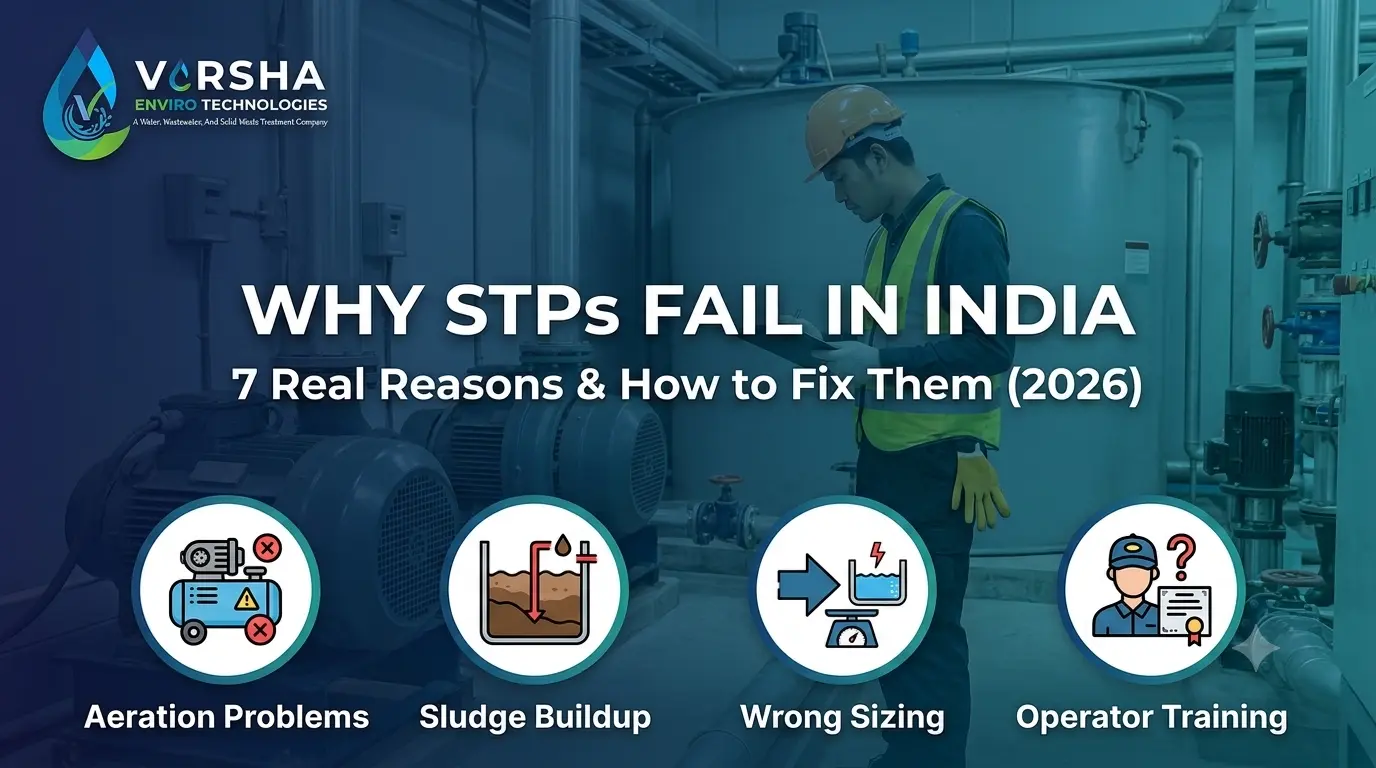
According to KSPCB audit data, approximately 80% of the 2,000 decentralised STPs installed in apartments across Karnataka do not meet the requisite treatment standards. This is not a Karnataka problem — it reflects a nationwide pattern. India installs thousands of sewage treatment plants every year, but a significant proportion of them stop performing reliably within 2–5 years of installation.
Understanding why STPs fail is the first step to running one that doesn’t. This guide covers the seven most common failure modes — with practical, actionable fixes for each.
Reason 1: Aeration Was Switched Off (The #1 Cause)
If there is one root cause that accounts for more STP failures in India than any other, it is this: someone switched off the aeration blowers.
Aerobic biological treatment — the core of every MBBR, SBR, and activated sludge STP — depends on continuous oxygen supply via aeration. The biological culture (bacteria) that breaks down sewage is aerobic — it requires dissolved oxygen (DO) of at least 2–4 mg/L continuously to function.
Why it happens:
- Electricity cost concern — blowers run 24/7 and consume power
- Noise complaints near residential areas — blowers generate mechanical noise
- Power cuts with no backup — blowers stop, aeration stops
- Deliberate shutdown during low-occupancy periods to “save” the plant
What actually happens: Within 8–24 hours of aeration stopping, dissolved oxygen drops to zero. Anaerobic conditions develop. The biological culture begins dying. The plant’s entire treatment capacity collapses — and takes weeks to rebuild through bioaugmentation and re-seeding.
The fix:
- Install a UPS or generator backup for blowers specifically (not just for lights and lifts)
- Use variable-frequency drive (VFD) blowers that can reduce speed (and noise/power) at low occupancy rather than being fully switched off
- Never switch off aeration — reduce it, never stop it
Reason 2: Wrong Sizing at Design Stage
Many STPs in India are sized on the building’s approved capacity on paper — number of flats × 2 BHK (2 persons) — rather than actual occupancy. In practice, a 200-flat society with 3-4 persons per flat generates 50–100% more sewage than a plant sized for 2 persons per flat accommodates.
Consequence: Hydraulic overloading — the plant receives more flow than it was designed to handle. Retention time in the biological treatment stage drops below the minimum needed for treatment, and effluent quality deteriorates even with perfect operation.
The fix: If your STP was sized for a lower population than currently occupies the building, it cannot be “maintained” into compliance — it needs capacity augmentation. Options:
- Adding equalization tank volume to buffer peak flows
- Adding another MBBR tank in parallel (often the most cost-effective expansion)
- Full capacity upgrade assessment by a qualified engineer
Varsha Enviro’s repair and maintenance services include plant capacity audits to identify whether underperformance is an operational or a sizing issue.
Reason 3: Sludge Was Never Removed
Secondary clarifiers and sludge collection sumps in biological STPs continuously accumulate sludge — settled biomass from the treatment process. This sludge must be periodically removed (wasted). When it isn’t:
- Accumulated sludge rises into the aeration zone, reducing effective tank volume
- Old, decaying sludge begins to die off, releasing BOD back into the treatment system
- The plant appears to be running but is actually recycling its own decaying sludge
- Odours intensify dramatically — dead sludge is the most common source of H₂S odour from STPs
The fix: Establish and follow a sludge wasting schedule — typically monthly to quarterly depending on plant load. Do not wait until odour complaints force the issue. Sludge wasting records should be maintained as they are required documentation for CTO renewal.
Reason 4: The STP Was Installed for the OC, Then Forgotten
This is the most widespread pattern in Indian residential buildings: developer installs a basic STP to secure the Occupancy Certificate, hands over the society, and the RWA inherits a plant with no operating manual, no AMC, no spares, and no operator training.
Within 12–18 months, the biological culture is disrupted. Diffusers are clogged. The multiport valve hasn’t been serviced. Nobody knows what “MLSS” means or why it matters. The plant continues to run mechanically (motor sounds, water flowing) but produces completely untreated effluent.
The signs:
- Treated water is dark-coloured or has strong odour
- Foam on the surface of the aeration tank (often indicates excessive detergent load or a dying biological culture)
- No one in the society maintenance team knows when the plant was last serviced
- No service records exist
The fix: Start with a qualified plant inspection to assess current condition. In many cases, the plant can be restored through:
- Desludging and cleaning all tanks
- Blower and diffuser service/replacement
- Biological culture re-seeding (bioaugmentation)
- Operator training
- AMC setup going forward
Full replacement is often not necessary — targeted restoration is more cost-effective. Varsha Enviro’s operation and maintenance services include restoration programs for long-neglected plants.
Reason 5: Toxic or High-Strength Input Disrupted the Biological Culture
Biological treatment systems are living systems — they can be killed by sudden exposure to:
- High chlorine: Common when housekeeping uses floor cleaning chemicals containing chlorine-based disinfectants that drain into the STP
- Extreme pH: Acid or alkali cleaning agents from kitchens and laundry
- Sudden high-TDS batch discharges: Brine from water softener regeneration discharged directly to the STP
- Industrial chemical exposure: In mixed-use developments where shops or workshops drain into the residential STP
When the biological culture is shocked, BOD/COD in the effluent spikes immediately — the plant continues to receive and pass sewage without treating it.
The signs:
- Sudden effluent quality deterioration after normal performance
- Absence of aeration foam (suggests dead biological culture)
- Grey/clear appearance of aeration tank (should be brown-tan)
- Significant drop in MLSS (Mixed Liquor Suspended Solids) readings if being monitored
The fix:
- Identify and eliminate the source of toxic input immediately
- Allow the plant to recover with continuous aeration and reduced load if possible
- Add biological culture (bio-culture/seed sludge from a functioning STP) to accelerate recovery
- Review all drainage connections into the STP to identify unintended industrial or chemical inputs
Reason 6: No Trained Operator
Running a biological STP is a technical job. The operator needs to understand:
- How to check dissolved oxygen and why it matters
- What MLSS means and what the target range is
- When to waste sludge and how much
- What normal aeration tank appearance looks like vs signs of trouble
- Basic parameter monitoring (pH, turbidity) and record-keeping
In many housing societies, STP “operation” is assigned to the same person who sweeps the lobby and maintains the lifts — with no training.
The fix:
- All STPs above 25 KLD should have a dedicated trained operator — either in-house or supplied through an AMC
- Operator training (usually 1–2 days for basic competency) should be included in any AMC contract
- Minimum monthly monitoring checklist should be documented and followed
Reason 7: Power Backup Was Not Provided
Related to Reason 1 but distinct: this is about infrastructure, not behaviour. An STP with no power backup is guaranteed to fail during the power cuts that are a routine part of Indian urban infrastructure — especially in Tier 2 cities and during monsoon season.
Even a 2-hour daily power cut, multiplied over weeks, cumulatively stresses the biological culture. Longer power cuts (6–8+ hours in some areas) can cause the biological culture to begin dying off.
The fix: At minimum, ensure the aeration blower circuit has backup power — either a small dedicated UPS or inclusion in the building’s generator automatic transfer switch. Blowers are the single most critical equipment; pumps can typically wait for power restoration but aeration cannot.
What to Do If Your STP Is Already Failing
Step 1: Get a plant inspection — Don’t guess. A qualified STP engineer can assess which of the above causes is responsible within a few hours of site inspection. Replacing equipment before diagnosing the cause is wasteful.
Step 2: Stop the source of failure — Toxic input, aeration-off habit, or a sludge overflow must be addressed before restoration can hold.
Step 3: Restore, don’t always replace — In most cases, a failing STP can be restored at 30–60% of replacement cost. Full replacement is only necessary when the civil structure is damaged, the plant is fundamentally undersized, or the equipment has completely failed.
Step 4: Set up an AMC — A functioning STP that has been restored will fail again without structured maintenance. See our guide on STP AMC and operation costs for what proper maintenance looks like.
Varsha Enviro’s repair and maintenance services cover STP restoration, troubleshooting, and ongoing AMC for plants across Delhi NCR, Haryana, and Jaipur.
Frequently Asked Questions
Q: My STP smells terrible. What’s the most likely cause? A: Foul odour from an STP is almost always caused by anaerobic conditions — either insufficient aeration (low DO) or sludge overaccumulation creating anaerobic pockets. Check dissolved oxygen first (should be 2–4 mg/L in the aeration zone). If DO is adequate, inspect sludge levels.
Q: The STP looks like it’s running but the effluent is black. What’s wrong? A: Black effluent indicates strongly anaerobic conditions in the treatment tanks — the biological culture has died or is in severe distress. Most common cause: aeration was shut off for a period. Requires biological culture re-seeding and careful restart.
Q: Can we use our society’s failing STP while it’s being restored? A: Generally yes — the plant can continue receiving sewage during restoration, though effluent quality will be below compliance during the recovery period. The restoration plan should be documented and if possible communicated to your SPCB (shows good faith if they inspect during this period).
Q: How long does it take for a biological culture to recover after a toxic shock? A: With continuous aeration, bioaugmentation (addition of culture), and a source of organic feed — 2–4 weeks for basic function recovery, 4–8 weeks for full compliant performance. Recovery time depends on severity of the shock and how quickly the toxic source is identified and removed.
Final Thoughts
An STP failing in India is almost never about the technology — MBBR, SBR, and MBR all work reliably when properly operated. The seven causes above are all operational and maintenance failures. Understanding them is the starting point for running an STP that stays compliant for its full 15–20 year design life. Contact Varsha Enviro for an STP health assessment if your plant is showing any of the warning signs above.