
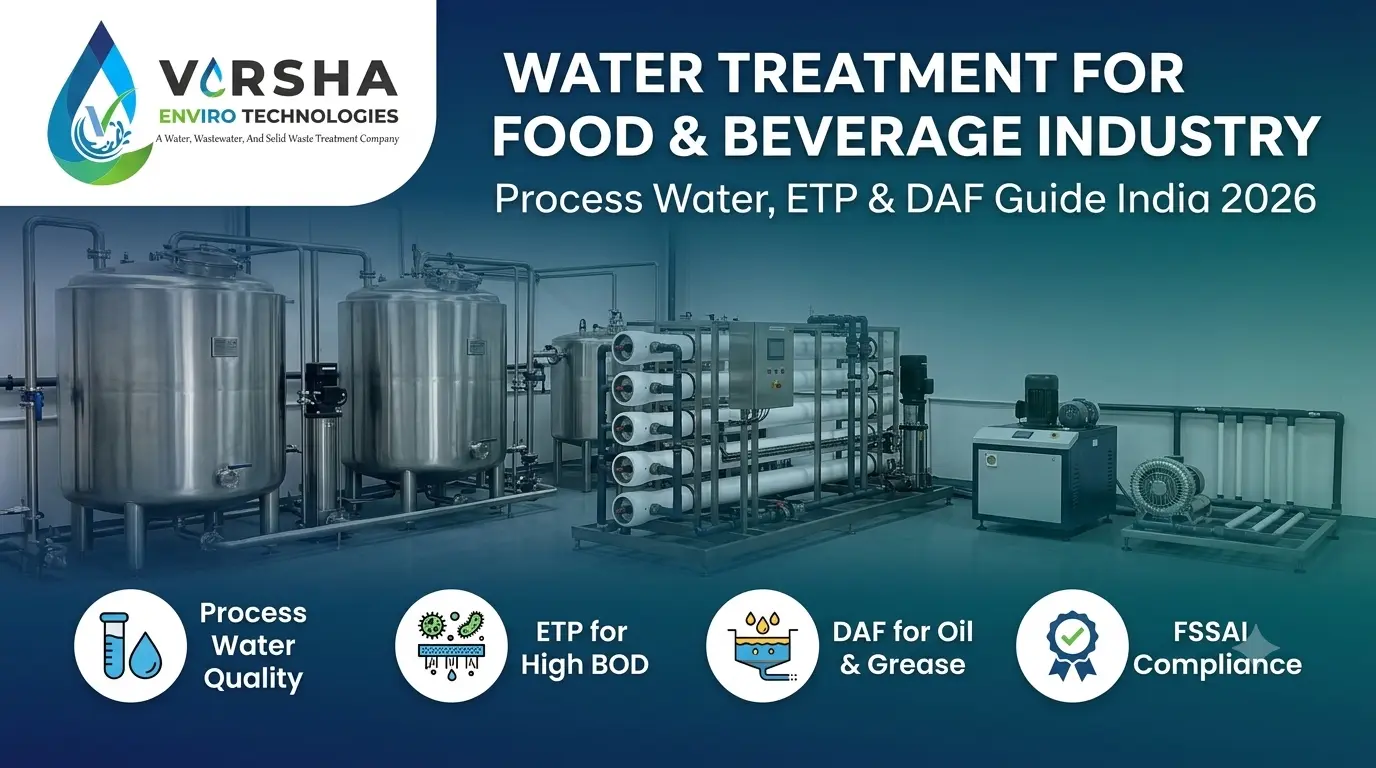
The food and beverage industry in India has two distinct water treatment requirements that are often addressed separately but are fundamentally connected: inbound water treatment (producing water pure enough for food-safe production) and outbound wastewater treatment (treating the high-BOD, high-oil effluent generated by food processing before discharge). Both are regulated — and both have real consequences if inadequately managed.
This guide covers the complete water treatment picture for food processing units, dairy plants, beverage manufacturers, and packaged food facilities operating in India in 2026.
The F&B Water Challenge in Two Directions
Inbound: Process water must be food-safe Food processing regulations (FSSAI, BIS, and specific product standards) require that water used in food contact applications — washing produce, food preparation, cleaning equipment, ice making, boiler steam, and beverage blending — meets defined quality standards. Using inadequately treated water in these applications creates food safety risk and regulatory exposure.
Outbound: Food processing effluent is extremely high in BOD/COD Food processing generates some of the highest organic load wastewater of any industry. Dairy plants, slaughterhouses, and packaged food units regularly produce effluent with COD of 80,000–100,000 mg/L before treatment — compared to domestic sewage at 300–500 mg/L COD. This massive organic load, combined with fats, oils, and grease (FOG), requires specific treatment design.
Inbound: Process Water Treatment Requirements for F&B
What FSSAI and BIS Require
Food Safety and Standards Authority of India (FSSAI) regulations require that water used in food production meets IS 10500 (Indian Standard for Drinking Water) at minimum. For specific applications, requirements are more stringent:
Critical water quality parameters for F&B process water:
- Turbidity: ≤1 NTU (for beverages and direct food contact)
- Total Coliform: Zero (for drinking water standard process applications)
- TDS: Typically 50–300 mg/L for beverage blending (product quality and taste)
- Hardness: Low (prevents scale in boilers, heat exchangers, and filling equipment)
- Chlorine residual: Adequate for sanitation but controlled (excess chlorine creates off-flavours)
- Iron and manganese: Very low (causes color and off-taste in products)
Standard Treatment Train for F&B Process Water
For facilities on municipal supply: Multimedia filtration → Activated carbon (chlorine removal, taste/odour) → Softener (hardness reduction) → UV sterilization → Storage
For bore well or river water sources (more common in Haryana/Rajasthan plants): Aeration (iron/manganese removal) → Multimedia filtration → RO plant (TDS reduction, bacteria removal) → Activated carbon → UV sterilization
For beverage manufacturing (where water is the product ingredient): The above train plus a demineralization plant or second-pass RO for precise TDS control — beverage recipes specify a target TDS range that must be consistently maintained for product consistency.
For steam/boiler use in food processing: Water softener plant plus DM plant depending on boiler pressure rating — softened water for low-pressure food-grade steam, DM water for higher-pressure boilers.
SS 316 vs SS 304 — Food-Grade Construction
All water treatment equipment in direct contact with food process water should be constructed in SS 316L (not the standard industrial SS 304). Food-grade sanitary fittings (tri-clamp connections, no dead legs) are required in FSSAI-regulated facilities. This adds cost but is essential for compliance and hygiene validation.
Outbound: ETP for Food Processing Effluent
Why Food Effluent Is Exceptionally High in BOD/COD
Food processing creates wastewater from:
- Washing and blanching of raw materials
- CIP (Clean-In-Place) cleaning of processing equipment (detergent-heavy)
- Product losses and spillage
- Packaging area wash-down
- Cooling water with food contact
Combined, this wastewater contains very high levels of organic matter (carbohydrates, proteins, fats) plus cleaning chemical residues. Typical COD ranges by F&B sub-sector:
| Sub-sector | Typical Influent COD |
|---|---|
| Dairy (milk processing, cheese) | 3,000 – 20,000 mg/L |
| Vegetable/fruit processing | 2,000 – 15,000 mg/L |
| Slaughterhouse / meat processing | 5,000 – 30,000 mg/L |
| Edible oil refinery | 10,000 – 50,000 mg/L |
| Packaged food / snack manufacturing | 5,000 – 25,000 mg/L |
| Brewery / distillery | 3,000 – 15,000 mg/L (beer); 30,000–80,000 mg/L (distillery) |
The good news for treatment design: food effluent typically has a high BOD/COD ratio (0.5–0.7) — meaning it is highly biodegradable. This makes biological treatment (MBBR/SBR) the primary cost-effective treatment method, unlike textile or pharmaceutical effluent.
DAF — Essential Pre-Treatment for F&B Effluent
Before biological treatment, food processing effluent with high fat, oil, and grease (FOG) requires a DAF (Dissolved Air Flotation) pre-treatment stage. Without it:
- FOG coats biological treatment media, reducing efficiency
- Aeration tanks develop persistent foam
- BOD/COD reduction in the biological stage is significantly impaired
A properly designed DAF with coagulant dosing removes 80–95% of FOG and 40–60% of suspended solids before the effluent reaches the biological stage — dramatically reducing the biological treatment load and improving overall system reliability.
Standard ETP Treatment Train for F&B Units
Equalization tank (flow/load balancing) → DAF with chemical dosing (FOG and SS removal) → Biological treatment — MBBR/SBR (BOD/COD reduction) → Secondary clarifier → Tertiary treatment (sand filtration + UV/chlorination if reuse intended) → Discharge or reuse
For high-volume food units with variable batch production schedules, the equalization tank is critical — it absorbs the difference between peak production discharge and the ETP’s design flow rate, preventing hydraulic overloading of the biological stage.
Cost Ranges for F&B ETP (India, 2026)
| Capacity | Approx. ETP Cost (Standard, with DAF) |
|---|---|
| 25–50 KLD (small food unit) | ₹20 – 50 lakhs |
| 50–100 KLD | ₹50 lakh – 1 crore |
| 100–250 KLD | ₹1 – 2.5 crore |
| 500 KLD+ | Custom quotation |
These estimates include equalization, DAF pre-treatment, biological stage, secondary clarification, and basic polishing. ZLD addition for units facing SPCB ZLD directives significantly increases cost — see our ZLD plant cost guide for ZLD-specific pricing.
Is ZLD Required for Food Processing Units?
Not universally — ZLD mandates in India are currently focused primarily on textile, pharmaceutical, tannery, and distillery sectors. However:
- Distilleries: ZLD is mandatory in most states. Distillery effluent (spent wash) has extremely high COD and is one of the most heavily regulated industries under ZLD directives
- Large food processing units in water-stressed areas may receive individual ZLD directives during CTO renewal — confirm your specific SPCB conditions
- Dairy units in some states facing groundwater concerns have received ZLD-direction communications from SPCBs
For non-ZLD food units, treated water reuse for floor washing, equipment pre-rinse, and garden irrigation is a practical water conservation step that reduces both freshwater consumption and effluent volume.
Varsha Enviro’s ETP solutions for food processing units incorporate DAF pre-treatment, high-rate biological treatment, and ZLD integration where required — serving food processing facilities across Haryana (Kundli, Sonipat, Rewari) and Rajasthan.
Water Audit — Reduce Consumption Before You Treat
One of the highest-ROI interventions in F&B facilities is a water audit before investing in ETP capacity. Common findings from water audits in Indian food plants:
- 20–40% of process water is lost to leaks, uncontrolled wash-downs, and unnecessary dilution
- CIP programs are often water-intensive by design — optimization can reduce CIP water by 30–40% without compromising hygiene
- Counter-current washing (using rinse water from the final stage as pre-rinse in the earlier stage) can significantly reduce total wash water consumption
Reducing water input at source directly reduces ETP capacity requirement and operating cost.
Frequently Asked Questions
Q: Does our food unit need a separate STP and ETP, or can one plant handle both sewage and process effluent? A: Ideally, domestic sewage from toilets and staff areas should be treated in a separate STP (or discharged to municipal sewer with permission) while process wastewater goes to the dedicated food-process ETP. Mixing the two streams complicates ETP design and can cause the domestic sewage to overload a system designed for low-volume high-strength food process effluent.
Q: Can food ETP treated water be reused for food washing or rinsing? A: No — ETP treated water from food process effluent should not be reused in food contact applications (washing raw materials, equipment rinsing). It is suitable for non-contact applications: garden irrigation, floor washing (non-food areas), fire-fighting reserve. Freshwater or properly purified process water must be used for all food contact applications.
Q: What BOD/COD does CPCB require for food ETP discharge? A: Standard CPCB norms for inland surface water discharge: BOD ≤30 mg/L, COD ≤250 mg/L. Food processing ETP, starting from COD of 10,000–80,000 mg/L, requires 99%+ COD removal — achievable with proper multi-stage treatment (DAF + biological + tertiary) but not with undersized or single-stage systems.
Q: How does seasonal production variation affect ETP design? A: Seasonal agricultural processing units (e.g., mango pulp processing, seasonal vegetable processing) have highly variable effluent generation — peak season vs off-season can differ by 5–10× in daily volume. The ETP equalization tank and biological system must be designed to handle this variability. MBBR/SBR with proper equalization handles seasonal variation better than fixed-rate continuous systems.
Final Thoughts
Water treatment in the food and beverage industry is not optional — both inbound process water quality (FSSAI compliance, product safety) and outbound effluent treatment (CPCB/SPCB compliance) are legal requirements with real enforcement consequences. The good news is that food effluent’s high biodegradability makes effective biological treatment achievable at lower cost than textile or pharmaceutical effluent — provided the DAF pre-treatment stage is properly designed and the biological stage is correctly sized and maintained.
Contact Varsha Enviro for a process water and ETP assessment for your food processing facility.