
For housing society RWA committees, facility managers, and industrial EHS teams, the sewage treatment plant sitting in the basement or utility yard is not just mechanical equipment — it is the single asset standing between your facility and its legal right to operate. Your Consent to Operate (CTO) under the Water (Prevention and Control of Pollution) Act 1974 is a continuing obligation, and your STP is how you fulfil it.
Yet AMC and operation cost is consistently the most underestimated expense in STP ownership. Here’s a realistic, capacity-wise breakdown of what proper STP operation and maintenance actually costs in India in 2026.
Why STP Maintenance Cannot Be Deferred
This point deserves clear emphasis before getting into numbers: an STP is a biological system, not a mechanical machine. Unlike a pump or motor that fails obviously when it stops working, an STP can appear operational while its biological treatment is gradually deteriorating — producing effluent that fails discharge norms even though the plant is “running.”
Consequences of deferred or inadequate maintenance:
- Compliance failure: Effluent quality that doesn’t meet CPCB/SPCB norms — BOD exceeding 30 mg/L, TSS exceeding 100 mg/L — makes every discharge a violation
- NGT/SPCB action: The National Green Tribunal has been actively passing closure orders against non-compliant facilities since 2015. Closure notices carry immediate operational impact
- Sludge accumulation: Unmaintained plants accumulate sludge that progressively reduces treatment capacity, causing cascading failures
- Equipment damage: Unmaintained aeration blowers, pumps, and dosing systems fail at the worst possible times — typically during high-occupancy periods
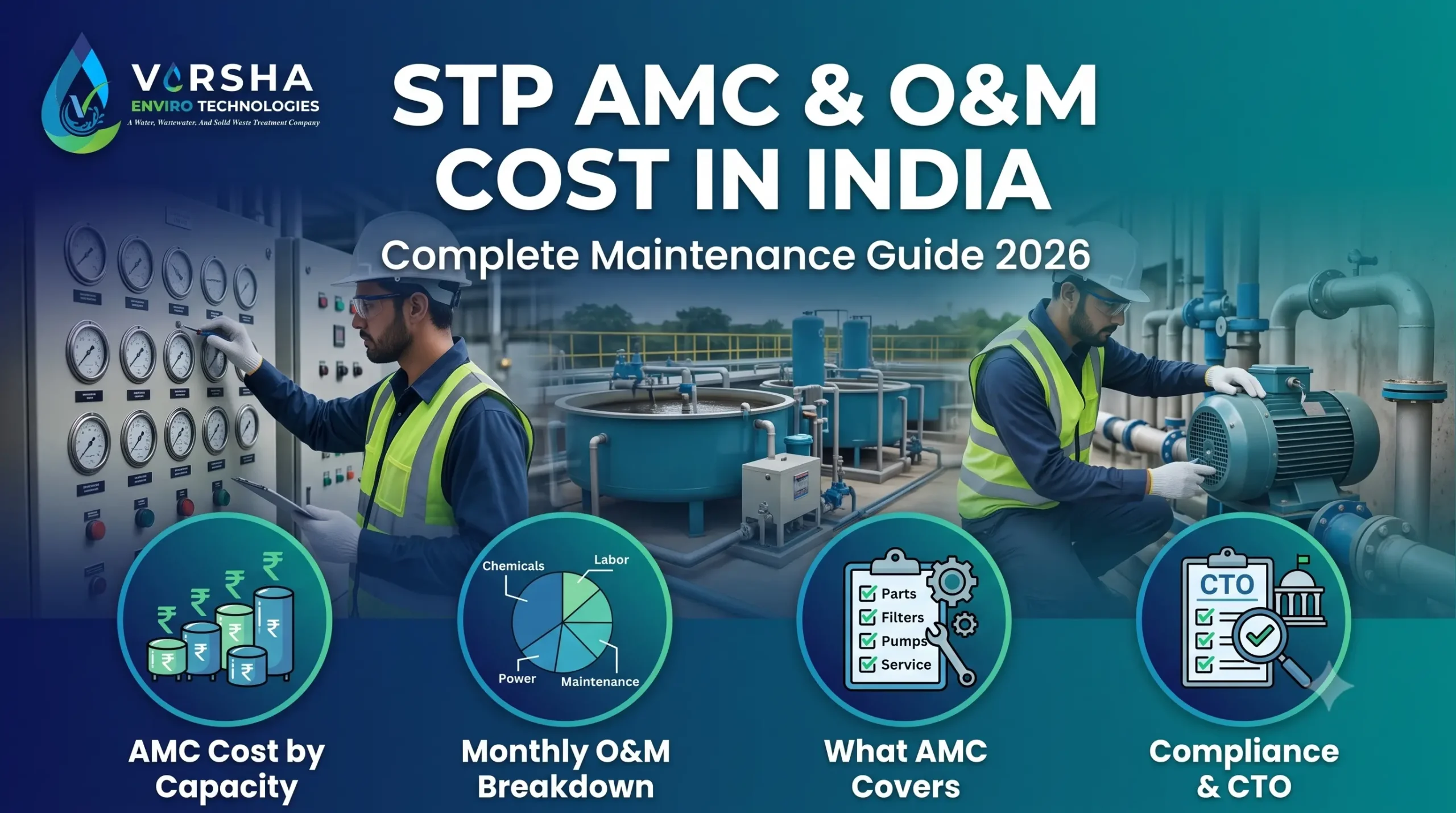
STP Monthly Operating Cost Breakdown (2026)
A realistic monthly O&M budget for an MBBR-based STP has several components:
1. Operator Cost
- Small plant (10-25 KLD): Part-time operator, shared with other duties — ₹3,000-6,000/month equivalent
- Medium plant (50-100 KLD): Dedicated operator, semi-skilled — ₹8,000-15,000/month
- Large plant (200+ KLD): Trained operator with shift coverage — ₹15,000-30,000+/month
2. Power Cost Aeration blowers are the primary power consumer in an MBBR STP, running continuously. Typical consumption:
- 10 KLD plant: 5-10 kWh/day
- 50 KLD plant: 20-35 kWh/day
- 100 KLD plant: 40-70 kWh/day
At India’s commercial electricity tariff of ₹7-12/kWh, power cost for a 100 KLD MBBR STP runs ₹8,000-25,000 per month — the single largest ongoing operating cost.
3. Chemical Cost Depends on influent characteristics but typically:
- Coagulant/flocculant dosing (where required): ₹2,000-5,000/month
- Disinfection (chlorine/NaOCl): ₹1,000-3,000/month
- pH correction chemicals (lime/acid as needed): Variable
4. Sludge Disposal Often the most underestimated recurring cost. Sludge from secondary clarifiers must be periodically removed, dewatered, and disposed of as per Hazardous Waste Management Rules (or solid waste rules, depending on classification). For residential STPs:
- Sludge disposal: ₹5,000-20,000 per removal cycle (monthly to quarterly depending on plant load)
5. Consumables and Minor Repairs Filter cartridges, diffuser cleaning, minor valve replacements, blower filter cleaning — typically ₹1,000-5,000/month.
AMC Cost by Plant Capacity (2026)
| Plant Capacity | Typical Monthly AMC Range | What’s Usually Included |
|---|---|---|
| 10-25 KLD (small residential) | ₹5,000 – 10,000 | Scheduled visits, basic parameters, minor repairs |
| 25-50 KLD | ₹8,000 – 15,000 | Bi-weekly visits, chemical dosing check, effluent testing |
| 50-100 KLD | ₹12,000 – 25,000 | Weekly visits, blower/pump service, sludge management |
| 100-200 KLD | ₹20,000 – 45,000 | Comprehensive O&M including operator support |
| 200+ KLD (industrial/large complex) | ₹40,000 – 1 lakh+ | Full operation team, daily monitoring, compliance reporting |
AMC cost varies by location (metro vs tier-2), vendor, scope of services, and whether operator deployment is included.
What a Good AMC Contract Must Cover
Many RWA committees and facility managers sign AMC contracts without knowing what’s actually included — then face surprise bills for work the vendor claims is “outside AMC scope.” Here’s what a comprehensive STP AMC should cover:
Included (must insist on):
- Scheduled inspection visits (frequency specified in contract — minimum bi-weekly for occupied buildings)
- Aeration blower maintenance and filter cleaning
- Pump inspection and lubrication
- Secondary clarifier sludge level monitoring
- Basic effluent quality parameters (BOD, COD, TSS sampling — at least quarterly)
- Emergency response time commitment (24-48 hours specified)
- Minor consumable replacement (diffusers, seals, small fittings)
Often excluded (clarify before signing):
- Major equipment replacement (blowers, pumps, control panels)
- Sludge disposal and transport (sometimes included, often not — clarify explicitly)
- Chemical cost (sometimes pass-through to client)
- Regulatory compliance documentation and CTO renewal support
Consent to Operate (CTO) Renewal — AMC’s Most Important Function
Many STP owners focus only on the physical maintenance aspects of AMC and overlook the most operationally critical function: maintaining the plant in the condition required for annual CTO renewal under the Water Act. A CTO is not a one-time formality — it requires the plant to demonstrate compliance through effluent quality records, inspection reports, and operator certification. An STP without a valid CTO puts the facility’s operating status at risk. Confirm whether your AMC provider includes documentation support for CTO renewal.
Common Failures That Drive Up Maintenance Costs
Understanding these failure patterns helps in proactive AMC management:
Aeration blower failure: The highest-impact single component failure. Blowers run 24/7 — bearing wear and filter neglect are the most common causes. Preventive quarterly bearing inspection dramatically extends service life.
Sludge overaccumulation: When sludge removal is delayed past the recommended interval, accumulated sludge rises into the aeration zone, disrupting biological treatment and requiring expensive recovery.
Media fouling (MBBR): Carrier media in MBBR plants can accumulate inorganic precipitates or grease over time, reducing their effective surface area. Periodic washing and chemical cleaning restores performance.
Diffuser clogging: Fine bubble diffusers gradually clog with calcium/mineral deposits in hard water conditions — increasing power consumption and reducing oxygen transfer efficiency.
Varsha Enviro’s AMC and repair services cover all standard STP maintenance requirements across MBBR, SBR, and MBR plants, with documented service records to support CTO renewal. For full operation and maintenance services including deployed operator support, see our dedicated O&M page.
Frequently Asked Questions
Q: What is the difference between AMC and full O&M contract? A: An AMC (Annual Maintenance Contract) typically covers scheduled maintenance visits, minor repairs, and consumables by an external vendor — the facility’s own staff handles day-to-day operation. A full O&M (Operation & Maintenance) contract includes the AMC scope plus deployed operator(s) who run the plant daily — appropriate for facilities without trained in-house staff.
Q: Is it cheaper to maintain an STP in-house vs AMC? A: For small plants (below 25 KLD), in-house maintenance with periodic vendor visits is often more economical. For plants above 50 KLD — where consistent biological process management, effluent sampling, and CTO compliance matter more — a structured AMC with a specialist vendor typically delivers better compliance outcomes than ad-hoc in-house maintenance.
Q: How often should effluent quality be tested? A: CPCB/SPCB requirements vary by state and facility type, but quarterly third-party effluent testing is the minimum for most CTO compliance purposes. Monthly in-house testing with basic parameters (BOD, COD, TSS, pH) is recommended for any plant above 25 KLD.
Q: What happens if our STP fails an effluent quality check? A: Consistent effluent quality failures can result in SPCB show-cause notices, direction to repair/upgrade within a specified timeline, and ultimately closure order if corrective action isn’t taken. This makes proactive maintenance investment significantly cheaper than reactive compliance recovery.
Final Thoughts
STP AMC and O&M costs in India for 2026 range from ₹5,000/month for small residential plants to ₹1 lakh+ for large industrial systems. These numbers are not optional add-ons — they are the cost of maintaining the legal right to operate and the functional continuity of your STP investment. See our guide to STP plant cost in India for complete investment planning across capital and recurring cost components.
Need an AMC quote or O&M support for your facility? Get in touch with our team.