
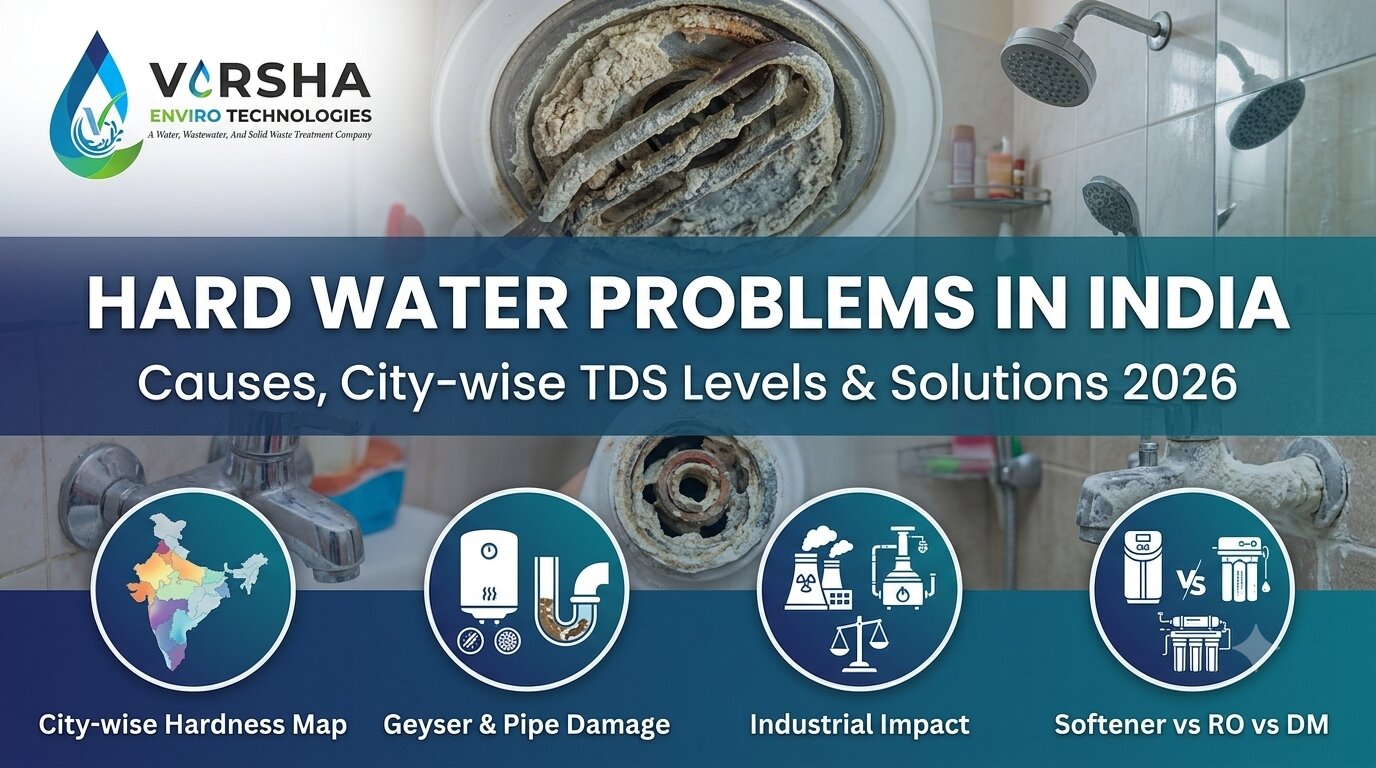
According to a Central Ground Water Board (CGWB) survey, approximately 65% of India’s groundwater is classified as “hard” or “very hard” — making hard water one of the most widespread and consistently underestimated water quality problems in Indian homes and industries. This guide covers what hard water actually is, what it’s doing to your pipes, appliances, and industrial equipment, and which treatment approach is right for your specific situation.
What Is Hard Water — and How Hard Is Too Hard?
Hard water contains elevated concentrations of dissolved calcium and magnesium minerals, typically expressed as calcium carbonate equivalent in mg/L or PPM:
| Hardness Level | Concentration (mg/L as CaCO₃) | Practical Effect |
|---|---|---|
| Soft | 0 – 75 mg/L | No scale, good lather |
| Moderately Hard | 75 – 150 mg/L | Slight scale in appliances |
| Hard | 150 – 300 mg/L | Visible scale on fixtures, reduced appliance life |
| Very Hard | 300 – 500 mg/L | Heavy scaling, pipe narrowing begins, treatment advised |
| Extremely Hard | Above 500 mg/L | Severe damage — treatment urgently needed |
Note: Hardness and TDS (Total Dissolved Solids) are related but different measures. A water source can have high TDS from dissolved salts that aren’t calcium/magnesium (and therefore aren’t “hardness” in the traditional sense). Hardness specifically refers to calcium and magnesium content.
City-wise Hard Water Levels Across India (2026)
Hard water severity varies enormously by location depending on groundwater geology and reliance on borewell versus surface water supply:
| City / Region | Typical Borewell TDS / Hardness | Practical Severity |
|---|---|---|
| Gurugram / Faridabad | 500–1,200 ppm | Very hard — major appliance risk |
| Jaipur | 600–1,800 ppm | Very hard to extremely hard |
| Delhi (municipal) | 200–450 ppm | Moderately hard |
| Delhi (borewell) | 400–900 ppm | Hard to very hard |
| Ahmedabad | 400–600 ppm | Very hard |
| Chennai (borewell) | Above 1,000 ppm in many areas | Extremely hard |
| Bengaluru (borewell) | 300–600 ppm in many areas | Hard to very hard |
| Mumbai (municipal) | 100–250 ppm | Soft to moderately hard |
| Pune | 150–300 ppm | Moderately hard |
| Rajasthan (general) | 600–2,500 ppm (borewell) | Extreme — mandatory treatment |
Rajasthan is India’s hardest water region — many districts have naturally occurring high-TDS, high-fluoride groundwater that creates both scaling and health concerns. If your facility or home relies on borewell water in Haryana or Rajasthan, water hardness is almost certainly affecting your equipment and infrastructure.
What Hard Water Is Doing to Your Home and Business
Pipes and Plumbing
Scale deposits form on the inner walls of all pipes carrying hard water. Over time — typically 5–10 years in very hard water areas — this scale narrows the effective pipe diameter by up to 50%, reducing water pressure and eventually requiring pipe replacement. CPVC and UPVC pipes fare better than GI pipes, but all are affected to varying degrees.
Geysers and Water Heaters
The heating element is where scale forms fastest — heating accelerates calcium carbonate precipitation onto the element surface. Scale is a thermal insulator: a 3mm layer of scale increases electricity consumption by approximately 25% as the element must work harder to heat water through the coating. Most geyser heating element failures in North and West India are accelerated by scale buildup.
Washing Machines
Scale deposits on drum bearings, heating elements, and inlet valves. Hard water also significantly reduces the effectiveness of detergent — calcium and magnesium bind to surfactant molecules before they can clean fabric. This is why clothes washed in hard water feel stiff and fade faster.
RO Membranes
Highly relevant for industries and homes with RO systems: hard water high in calcium, magnesium, and silica causes scaling on RO membranes — one of the primary causes of premature RO membrane failure in India. Proper pre-treatment (softening or antiscalant dosing) before the RO stage is essential to protect membrane investment.
Industrial Cooling Towers
Cooling towers concentrate dissolved minerals through evaporation — the circulating water TDS increases 3–5× above the makeup water TDS over time. In hard water regions, this concentration rapidly causes severe scale on heat exchanger tubes, fill media, and nozzles — reducing cooling efficiency and increasing energy consumption. Industrial facilities in Gurugram and Jaipur running cooling towers on borewell water without treatment face this problem routinely.
Boilers
Scale in boilers is not just an efficiency problem — it’s a safety issue. A 6mm scale layer on boiler tubes requires 40–50% more fuel to maintain the same steam output, and at sufficient thickness, can cause tube overheating and rupture. Boiler feed water treatment is mandatory for any boiler above low pressure.
Hard Water Solutions — Which Treatment for Which Application?
Water Softener Plant — Best for Most Applications
Ion exchange softening replaces calcium and magnesium ions with sodium ions, eliminating hardness. The treated water remains the same TDS but no longer forms scale:
- Residential (whole-home protection): Softener at the overhead tank inlet protects all outlets — geysers, washing machines, pipes, bathroom fittings
- Commercial/industrial (boiler feed, cooling tower makeup): Industrial softener plant removes hardness before water enters boilers, heat exchangers, and cooling systems
- Does NOT reduce TDS — if TDS reduction is also needed (for drinking water or specific industrial processes), RO is required
See our water softener plant solutions for residential, commercial, and industrial capacity options.
RO Plant — When TDS Reduction Is Needed
An RO plant removes both hardness and TDS — but at a higher operating cost per litre than a softener. Use RO when:
- Water is for drinking and the TDS is above 500 ppm (or BIS recommended 300 ppm limit)
- Industrial process requires both low hardness AND low TDS
- Where both softening and TDS reduction are needed, a softener before the RO extends membrane life and reduces operating cost
See our industrial RO plant guide.
DM Plant — For Boilers and High-Purity Industrial Applications
A demineralization plant removes virtually all dissolved minerals — including hardness — to produce near-zero conductivity water. Required for:
- High-pressure boilers (above 17–40 bar depending on boiler specification)
- Pharmaceutical process water
- Electronics manufacturing
For most residential and standard commercial applications, a DM plant is more than needed — a softener or RO is the appropriate solution.
Antiscalant Dosing — For Industrial Cooling Systems
Antiscalant chemicals dosed into cooling tower makeup water prevent calcium and magnesium from precipitating as scale — they remain in solution even at high concentration factors. This is the most cost-effective approach for large cooling systems where the water volume makes softening or RO prohibitively expensive.
Industrial Hard Water Impact — The Costs Add Up
For an industry running a 1,000 m³/day cooling tower on hard water without treatment in Gurugram or Jaipur:
- Heat exchanger fouling reduces cooling efficiency by 20–30% → higher chiller energy cost
- Annual tube cleaning and descaling maintenance
- Premature replacement of fill media
- Risk of Legionella growth in stagnant scale deposits (compliance and health risk)
The annual cost of untreated hard water in industrial cooling systems typically exceeds the cost of proper water softening or antiscalant treatment by 3–5×. Talk to our team for a water quality assessment and treatment recommendation for your facility.
Frequently Asked Questions
Q: Is hard water harmful to drink? A: Hard water itself is not acutely harmful — calcium and magnesium are not toxic and are actually essential dietary minerals. Very hard water (above 500 ppm) has an unpleasant taste and may contribute to kidney stone risk in susceptible individuals. The main concern from hard water is equipment damage and scale buildup, not health effects from drinking.
Q: Can boiling water reduce hardness? A: Boiling reduces “temporary hardness” (caused by calcium bicarbonate) by precipitating calcium carbonate — this is why a kettle gets scale inside. However, “permanent hardness” (from calcium sulfate and chloride) is unaffected by boiling. In practice, most Indian groundwater has a mix of both, so boiling reduces but does not eliminate hardness.
Q: Is a salt-free water softener effective for Indian hard water? A: Salt-free systems (template-assisted crystallization, magnetic conditioners) change the physical structure of calcium and magnesium minerals so they don’t adhere to surfaces, but they do not actually remove hardness from water. Effectiveness is debated and application-specific. For industrial applications and heavily scaled situations, conventional ion-exchange softeners provide more reliable and measurable hardness removal.
Q: How do I know if my water is hard? A: A simple TDS meter gives a rough indication — if your borewell TDS is above 300 ppm in the Delhi NCR, Haryana, or Rajasthan region, it’s almost certainly hard. For a precise hardness measurement (as CaCO₃), a basic water test from a certified lab (NABL accredited) costs ₹500–2,000 and gives you hardness, TDS, pH, and other key parameters.
Q: How long does a softener resin last in hard water areas like Gurugram or Jaipur? A: In very hard water conditions (above 500 ppm), resin life is typically 2–3 years. Pre-treating to remove iron and silt before the softener significantly extends resin life. Regular regeneration (with salt) and periodic resin cleaning extend service intervals.
Final Thoughts
Hard water is a national problem in India — but it’s a solved problem. The right treatment depends on your application: a softener for scale prevention, RO where TDS reduction is also needed, DM plant for high-purity industrial applications, and antiscalant dosing for large industrial cooling systems. Starting with a water quality test — knowing your actual TDS and hardness level — is always the right first step before investing in treatment equipment. Contact Varsha Enviro for a water analysis and treatment recommendation for your home, building, or industrial facility.