
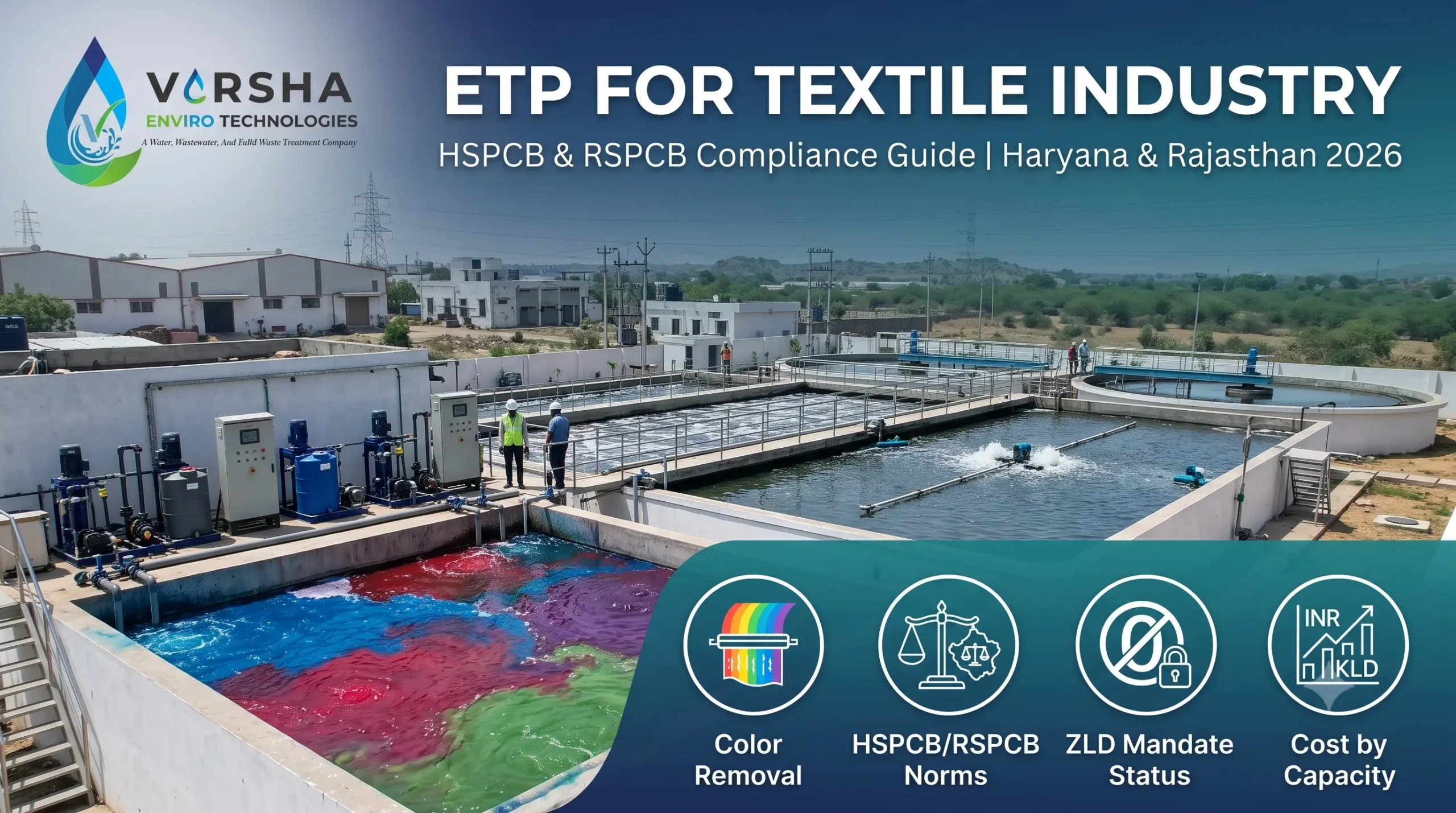
Textile dyeing and processing units in Haryana and Rajasthan face some of the most demanding effluent treatment requirements in Indian industry — high-color wastewater, elevated COD, often low biodegradability, and increasingly stringent State Pollution Control Board enforcement that has moved well beyond generic compliance reminders.
This guide covers everything a textile unit in Bhiwadi, Manesar, Faridabad, Sanganer, Bagru, or Bhilwara needs to know about ETP requirements, HSPCB and RSPCB compliance specifics, and current treatment approaches in 2026.
Why Textile Effluent Is Harder to Treat Than Generic Industrial Wastewater
Textile dyeing effluent is uniquely challenging for three reasons:
1. High color load: Reactive, acid, vat, and disperse dyes used in processing have complex molecular structures that standard biological treatment cannot break down effectively. Even after the BOD is reduced to compliant levels, the treated water can still appear colored — and CPCB/SPCB norms in most states now specifically address color removal.
2. Low BOD/COD ratio: Most textile effluents have a BOD/COD ratio below 0.3 — indicating significant non-biodegradable content. This means biological treatment alone (MBBR/SBR) cannot reduce COD to the ≤250 mg/L CPCB limit. Chemical/physical treatment stages are mandatory, not optional add-ons.
3. High TDS and salinity: Textile processing uses significant quantities of salts (sodium chloride, sodium sulfate) in dye fixation. This contributes high TDS to the effluent — a challenge for facilities facing ZLD requirements, since high-TDS concentrate is more expensive to evaporate.
Standard ETP Treatment Stages for Textile Units
An effective textile ETP in 2026 requires multiple stages. Facilities that cut costs by skipping stages consistently fail compliance:
Stage 1: Pre-treatment
- Bar screening: Removes fibers, lint, and solid debris
- Oil & grease trap: Captures finishing agent residues
- pH correction: Textile effluent pH swings widely (3.5–11) depending on process — neutralization before biological treatment is essential to protect the biological culture
Stage 2: Primary Treatment (Physical/Chemical)
- Equalization tank: Critical for textile units where effluent composition changes dramatically between shifts and dye batches. Averages out flow and pollutant load to protect downstream treatment
- Coagulation + flocculation: Alum, PAC, or ferric chloride dosed to aggregate colloidal dye particles and suspended solids
- Primary clarifier / DAF: DAF (Dissolved Air Flotation) is particularly effective for textile effluent with high suspended solids and colloidal dye matter — significantly reduces color load and COD before biological stage
Stage 3: Biological Treatment
- MBBR or SBR: Reduces biodegradable COD and BOD. For textile effluent with BOD/COD ratio 0.25–0.35, biological treatment reduces BOD to compliance but typically cannot achieve COD ≤250 mg/L alone
- Note: Some azo dyes are toxic to standard aerobic biological cultures — microbiological seed culture selection and acclimation are important for textile ETPs
Stage 4: Chemical/Advanced Oxidation (Mandatory for Most Textile Effluent)
- Fenton oxidation (H2O2 + FeSO4 at pH 3–5): Achieves 70–85% COD reduction on residual non-biodegradable organics — the most widely used AOP for textile effluent in India
- Ozonation: Effective for color removal and COD polishing, higher energy cost than Fenton
- Without this stage, most textile ETPs cannot achieve COD ≤250 mg/L and color removal simultaneously
Stage 5: Tertiary Treatment / Polishing
- Sand filtration + activated carbon: Removes residual color and trace organics
- RO (where ZLD compliance required): Concentrates remaining dissolved salts for thermal evaporation
Stage 6: Sludge Treatment
- Filter press / sludge dewatering: Textile ETP sludge contains dye compounds and may be classified as hazardous waste (Category 33 under Hazardous Waste Management Rules) — proper manifested disposal is mandatory, not optional
HSPCB (Haryana) — Specific Requirements for Textile Units
Haryana’s textile clusters — concentrated in Faridabad, Panipat (hosiery/knitwear), and Manesar/Gurgaon area — fall under HSPCB’s Consent to Establish and Consent to Operate regime with specific conditions for textile processing units:
Discharge standards (HSPCB, inland surface water):
- BOD: ≤30 mg/L
- COD: ≤250 mg/L
- Color: Significantly controlled — visible coloration not permitted
- TDS: ≤2,100 mg/L (critical for high-salt textile effluent)
- pH: 6.5–9.0
HSPCB enforcement reality (2026): HSPCB has increased inspection frequency in the IMT Manesar and Faridabad industrial estates, with surprise visits particularly targeting high-water-use industries including textiles. HSPCB’s online compliance monitoring system now requires submission of effluent quality data quarterly.
ZLD status in Haryana: Currently not a blanket mandate for all textile units in Haryana, but HSPCB has directed specific large-volume dyeing units and cluster ETPs to install ZLD. Units generating above a threshold daily volume are increasingly receiving individual ZLD directives during CTO renewal — confirm your specific HSPCB consent conditions before your next renewal.
RSPCB (Rajasthan) — Specific Requirements for Sanganer/Bagru/Bhilwara
Rajasthan’s textile clusters — Sanganer and Bagru near Jaipur (block printing + dyeing), Bhilwara (synthetic textile processing), and Pali (textile dyeing, historically one of India’s most polluted textile clusters) — face some of India’s strictest textile effluent enforcement.
The Pali history context: Pali district’s Bandi river became one of India’s most documented textile pollution cases, leading to CPCB intervention, closure orders, and mandatory CETP development. This history directly shapes RSPCB’s current approach to textile compliance — it is enforcement-first, not education-first.
Sanganer/Jaipur-specific situation: The Sanganer block printing and dyeing cluster generates high-color effluent that flows into the Dravyavati River system. RSPCB has been actively enforcing here, with regular sampling of treated effluent and groundwater in the vicinity of dyeing units.
RSPCB ZLD mandate (Rajasthan textile): Rajasthan has one of India’s more aggressive ZLD push timelines for textile units. Dyeing and processing units above certain discharge volumes in RSPCB’s priority clusters face active ZLD directives. For units in Sanganer, Bagru, and Pali, ZLD compliance is not a future consideration — it is a current enforcement requirement in many cases.
For units facing ZLD requirements, see our ZLD plant solutions guide for implementation timeline, technology choices (MEE vs MVR), and realistic cost ranges.
Cost Ranges for Textile ETP in Haryana & Rajasthan (2026)
Textile ETP costs significantly more than standard industrial ETP due to the additional chemical/AOP treatment stage, DAF pre-treatment, and sludge handling requirements:
| Plant Capacity | Approx. Cost Range (Multi-stage, Compliance-grade) |
|---|---|
| 50 KLD (small dyeing unit) | ₹30 – 60 lakhs |
| 100 KLD (mid-size textile unit) | ₹60 lakh – 1.2 crore |
| 250 KLD (large processing unit) | ₹1.2 – 2.5 crore |
| 500 KLD (large factory / CETP contribution) | ₹2.5 – 5 crore |
Add ZLD (RO + MEE/MVR evaporation) for units with ZLD directives: approximately 3–5x the cost of the conventional ETP for the same capacity.
Monthly operating costs for a 100 KLD textile ETP: Chemical cost (coagulants, H2O2, acid/alkali for pH control, activated carbon) typically ₹40,000–80,000/month — significantly higher than non-textile industrial ETPs.
Varsha Enviro’s ETP solutions for textile units are designed around your specific effluent characterization — incorporating coagulation/flocculation, biological treatment, Fenton/AOP polishing, and ZLD integration for units with HSPCB or RSPCB ZLD directives — with installations across Haryana and Jaipur/Rajasthan.
Common Mistakes Textile Units Make With Their ETP
Skipping the equalization tank: Textile effluent composition changes dramatically batch-to-batch. Without equalization, downstream biological treatment is subjected to toxic shock loads that kill the biological culture periodically — requiring expensive culture reseeding and causing compliance gaps.
Undersizing for peak load: Designing for average daily flow, not peak batch discharge. When a large dye batch hits an undersized equalization tank, untreated effluent overflows.
Skipping or undersizing the AOP stage: The most common reason textile ETPs fail COD compliance while appearing to run normally. Without Fenton or equivalent AOP, non-biodegradable COD never reaches ≤250 mg/L.
Improper sludge disposal: Textile ETP sludge classified as Hazardous Waste Category 33 must go through a licensed TSDF (Treatment Storage Disposal Facility) with manifests — disposing informally creates criminal liability under Hazardous Waste Management Rules.
Frequently Asked Questions
Q: Can a standard MBBR-based ETP treat textile dyeing effluent? A: MBBR-based biological treatment alone is insufficient for most textile effluent due to the low BOD/COD ratio and non-biodegradable color compounds. A multi-stage system with chemical coagulation, biological treatment, and AOP (Fenton or ozonation) is the minimum requirement for consistent compliance.
Q: What is the color standard for textile effluent discharge in India? A: CPCB does not set a specific color value in mg/Pt units in the general standards, but requires treated effluent to be “visually acceptable” — and most SPCBs, including RSPCB and HSPCB, specifically prohibit visible coloration in treated effluent. This effectively requires tertiary treatment for most dyed effluent streams.
Q: Are textile units in Haryana required to join a CETP? A: In some industrial clusters with established Common Effluent Treatment Plants (CETPs), individual units are required to pre-treat effluent to inlet standards and discharge to the CETP rather than separately. Check your specific HSPCB consent conditions and industrial estate rules. For more on CETP see our CETP guide.
Q: How often does textile ETP sludge need to be removed? A: Depends on processing volume and ETP design, but most mid-size textile units (100 KLD) generate sludge requiring monthly to bi-monthly removal. Delayed sludge removal causes sludge to overflow into aeration zones, disrupting biological treatment.
Q: Is ZLD feasible for small dyeing units (below 50 KLD)? A: Technically feasible but economically challenging — the capital cost of ZLD relative to treated water volume is high at small scale. RSPCB and HSPCB both have provisions for small units, including participation in CETP systems as an alternative to individual ZLD. Verify your specific consent conditions.
Final Thoughts
Textile ETP compliance in Haryana and Rajasthan in 2026 is a serious operational matter — not a checkbox. The combination of high-color non-biodegradable effluent, state-board enforcement that has intensified significantly, and growing ZLD directives for specific clusters means that underpowered or poorly maintained ETPs are creating real business risk for their operators.
The starting point is always effluent characterization — get your actual BOD, COD, color, TDS, and BOD/COD ratio tested before designing or upgrading an ETP. Everything flows from those numbers. Contact Varsha Enviro for a consultation and effluent assessment for your facility.