
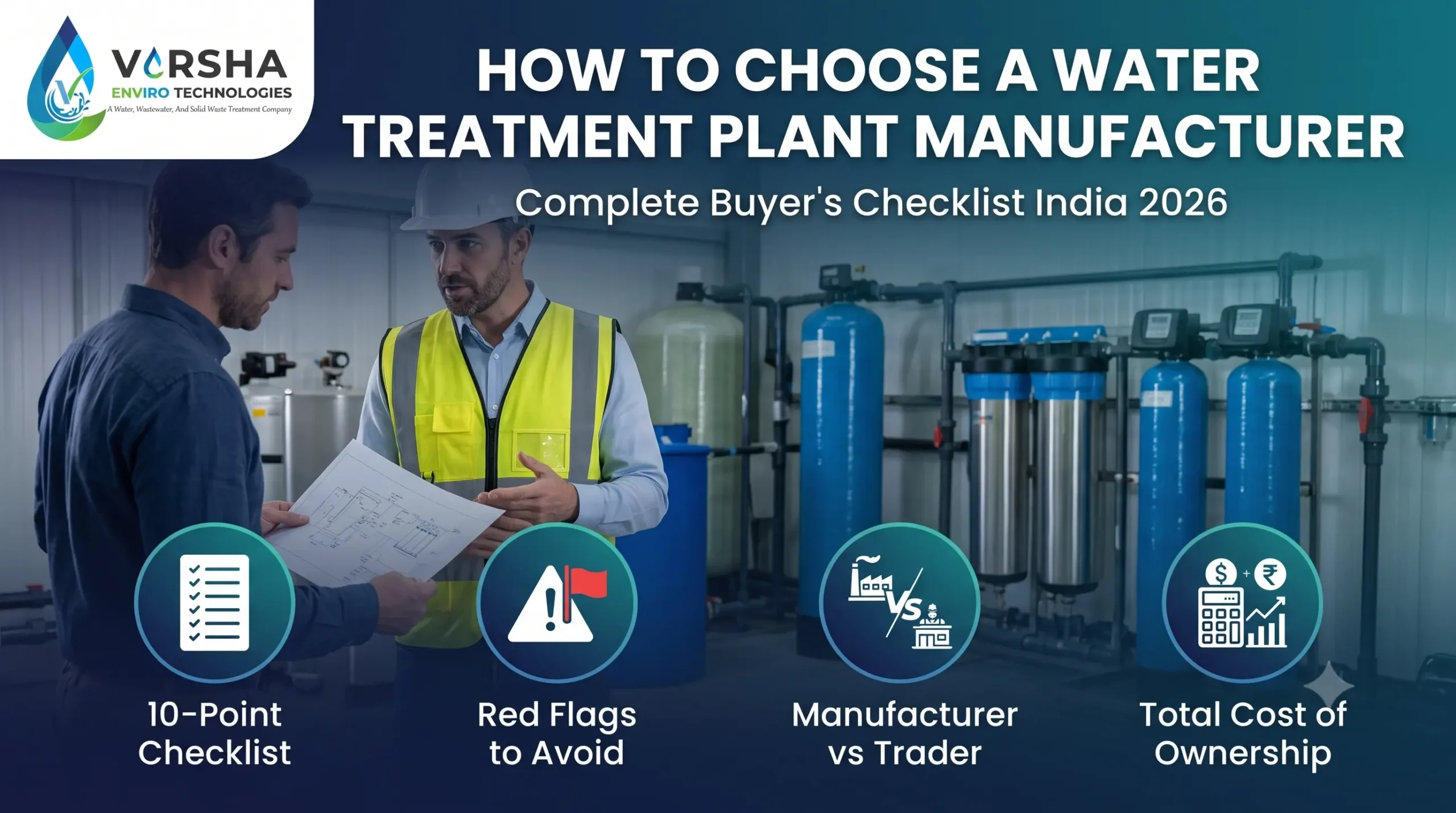
Buying a sewage treatment plant, effluent treatment plant, or industrial water treatment system is not like buying a pump or a motor. It is a 15–20 year commitment to a system that must run every day, stay inside your discharge norm continuously, and not fail when a pollution control board inspector shows up. The consequences of choosing wrong don’t appear in the quote — they appear 18 months later as a corroded tank, a failed compliance test, or a phone number that no longer answers.
This guide gives you a structured checklist to evaluate any water treatment plant manufacturer in India — before signing any quotation.
Manufacturer vs. Trader — The Most Important Distinction Nobody Explains
Many companies presenting as “manufacturers” in India are actually traders — they source equipment from multiple fabricators, assemble it under their brand, and focus on sales rather than engineering. This distinction matters enormously for a system that must stay compliant for two decades.
A genuine manufacturer:
- Has their own fabrication facility (ask for the factory address and visit if possible)
- Has in-house engineering team that designs from your specific load/effluent data
- Can provide commissioning test reports from their own installations
- Has a service and spare parts network that exists after the sale
A trader:
- Sources hardware from multiple vendors and resells it
- Often cannot provide design calculations or engineering rationale
- Frequently unavailable for post-installation support
- May offer the lowest quote because they’ve taken the lowest-cost components
The test: ask them where the system is fabricated, who designed the treatment process, and for the CV of the engineer responsible for your project’s design. A real manufacturer answers this easily. A trader deflects.
The 10-Point Manufacturer Evaluation Checklist
1. Do They Design From Your Actual Data — or a Stock Package?
The first red flag: a vendor who quotes a price before seeing your sewage flow rates, effluent composition, or site conditions. An STP or ETP is custom-engineered — the right design begins with your actual numbers, not a catalogue.
✅ Right: “Please share your water meter readings / effluent characterization report so we can size the system correctly.” 🚩 Wrong: “For your building size, our standard 100 KLD package is ₹X.”
2. Can They Demonstrate CPCB/SPCB Compliance From Completed Projects?
Ask for commissioning test reports from 2–3 similar installations — not brochures, not testimonials, but actual lab effluent quality reports showing BOD, COD, TSS results at the outlet. A company that has delivered compliant plants will have these readily available.
For your specific compliance framework — whether it’s CPCB general standards, HSPCB conditions (Haryana), DPCC (Delhi), or RSPCB (Rajasthan) — confirm they have experience with that specific board’s norms and documentation requirements.
3. What Is the Material of Construction — and Why?
This question separates engineers from salespeople. The answer should be specific to your application:
- FRP vessels for standard water treatment applications — appropriate cost
- SS 304 for food/pharma contact surfaces — justified premium
- SS 316L for high-chloride or aggressive environments
A vendor who answers “we use high-quality materials” without specifying grade and rationale is not giving you an engineering answer. Ask for material specifications in writing as part of the quotation.
4. Is the Scope Itemised — or a Single Bundled Number?
A trustworthy quotation breaks the scope into: equipment (each stage itemised), civil work, electrical and instrumentation, piping, commissioning and trial run, operator training, and AMC terms.
A bundled single number is impossible to compare across vendors — it often hides what’s included and what’s not. Scope gaps (civil excluded, electrical excluded, commissioning not included) show up as cost overruns after the PO is signed.
5. What Is Their After-Sales and AMC Track Record?
Your plant will need servicing within the first 6–12 months — routine maintenance, diffuser cleaning, resin or media checks, effluent sampling. Ask specifically:
- Do they have a service team in your city/region?
- What is their AMC response time commitment for breakdown calls?
- How many plants do they currently service on AMC contracts?
A manufacturer with 50 plants under active AMC has a service infrastructure. A manufacturer who has sold 500 plants but services 10 on AMC has already moved on from their installations.
Varsha Enviro’s repair and maintenance services and operation and maintenance services provide structured AMC and O&M coverage across Delhi NCR, Haryana, and Jaipur.
6. Do They Handle Turnkey — or Equipment-Only Supply?
Equipment-only supply creates a coordination risk: your civil contractor, the equipment vendor, and the electrician are three separate parties whose work must integrate at commissioning. Any interface gap becomes your problem to resolve.
A genuine turnkey EPC (Engineering, Procurement, Construction) contractor takes single-point responsibility from design through commissioning — and is accountable if the final installed system doesn’t achieve the design performance.
7. What Technology Do They Recommend — and Can They Justify It?
The technology recommendation (MBBR vs SBR vs MBR for an STP; biological vs chemical+biological for an ETP) should come with a clear engineering rationale tied to your specific application:
- Why MBBR over MBR for your society? (Likely: cost + operation simplicity for standard compliance)
- Why biological treatment over chemical-only for your effluent? (Likely: BOD/COD ratio above 0.4)
- Why RO + DM instead of RO alone for your boiler? (Likely: high-pressure boiler requiring near-zero conductivity)
If they cannot explain the technology recommendation in terms of your specific requirements, they are proposing a catalogue solution, not an engineered one.
8. Have They Worked With Similar Projects in Scale and Industry?
Experience in your specific application matters. A company that has delivered 50 housing society STPs in Delhi NCR has navigated basement installations, compact footprints, noise/odour concerns relevant to residential settings, and Haryana-specific HSPCB documentation requirements. That experience is worth more than a company that has delivered 5 municipal ETPs and is now pitching your residential project.
Ask for 2–3 reference projects with contact details you can verify. A confident manufacturer will provide them without hesitation.
9. What Is the Real Total Cost of Ownership Over 10 Years?
The purchase price is one number. The 10-year total cost of ownership is a very different number, and it’s the one that actually matters for budget planning. Get this broken down:
- Annual power cost (based on their stated connected load, not a generic estimate)
- Annual chemical consumption cost
- Annual AMC cost
- Expected membrane replacement cycle and cost (for MBR/RO systems)
- Resin replacement schedule and cost (for DM/softener systems)
- Sludge disposal frequency and cost
A low-price vendor using undersized aeration or low-efficiency blowers may save ₹5 lakh on purchase price while adding ₹2–3 lakh per year in power cost. Over 10 years, that comparison inverts completely.
10. Do They Support CTO/Consent Documentation?
This is the compliance dimension that’s often missed until the first renewal cycle. Your Consent to Operate (CTO) under the Water Act requires:
- Effluent quality test reports from an accredited lab
- Operating records (maintenance logs, operator training records)
- Sometimes: vendor certification that the plant meets design specifications
A manufacturer who has been through this process for multiple clients will have templates and documentation support ready. A first-timer will leave you to figure it out yourself.
Red Flags — Walk Away If You See These
- Quotes without site visit or data review: Guessing, not engineering
- No itemised scope: Hiding exclusions that become extras later
- Vague technology recommendation: “We use the best technology” is not an answer
- No commissioning test report from existing installations: Cannot prove their plants work
- No service presence in your region: You are buying an orphan
- Lowest price by a large margin: Lowest prices come from somewhere — usually materials, design time, or scope gaps
- Reluctance to provide reference client contacts: They have something to hide
Why “Since 2015” Matters — Experience in Your Region
A manufacturer with 10+ years of installations in Delhi NCR, Haryana, and Rajasthan has navigated the specific compliance requirements of HSPCB, DPCC, and RSPCB. They understand that Haryana’s IMT cluster inspections are more frequent than national averages, that Jaipur’s groundwater sensitivity makes RSPCB stricter on certain discharge parameters, and that Delhi NCR basement installations have specific space and odour management requirements.
Varsha Enviro Technologies has been delivering STP plants, ETP systems, RO plants, ZLD systems, and water treatment solutions across this region since 2015 — with turnkey EPC capability and structured AMC support.
Frequently Asked Questions
Q: How many quotes should I get before deciding? A: Three is the practical minimum — enough to compare scope, technology, and price without creating an unmanageable evaluation process. More than five vendors typically just adds noise; the evaluation dimensions above matter more than quote volume.
Q: Should I always choose the cheapest quote? A: No — the cheapest quote for a 20-year compliance asset is almost always the most expensive decision when evaluated over the system’s lifetime. Compare on total cost of ownership, scope completeness, and documented performance from similar installations.
Q: Is it better to choose a local manufacturer or a national company? A: Both can be excellent choices. The critical factor is service presence in your region after sale — a national company with no local service team creates the same support gap as a distant manufacturer. Confirm actual service coverage, not claimed coverage.
Q: What warranty should I expect? A: Equipment warranty of 12–24 months is standard. Civil structures carry longer implied liability. More important than warranty duration is the vendor’s AMC track record and service presence — warranty means nothing if the vendor cannot be reached when needed.
Q: Can I upgrade my STP technology later if I start with MBBR and need MBR quality later? A: In many cases yes — existing civil structures can accommodate technology upgrades. This is worth discussing with your vendor at the design stage, as designing for future upgrade path is simpler than retrofitting an incompatible structure.
Final Thoughts
Choosing a water treatment plant manufacturer in India in 2026 is a 15–20 year decision. The 10 questions above, applied honestly to any vendor you’re evaluating, will separate genuine engineering partners from catalogue salespeople. Apply the total cost of ownership lens, verify references, and insist on itemised scope before signing anything.
Ready to put these questions to us? Start a conversation with Varsha Enviro — site visit and design basis assessment at no obligation.