
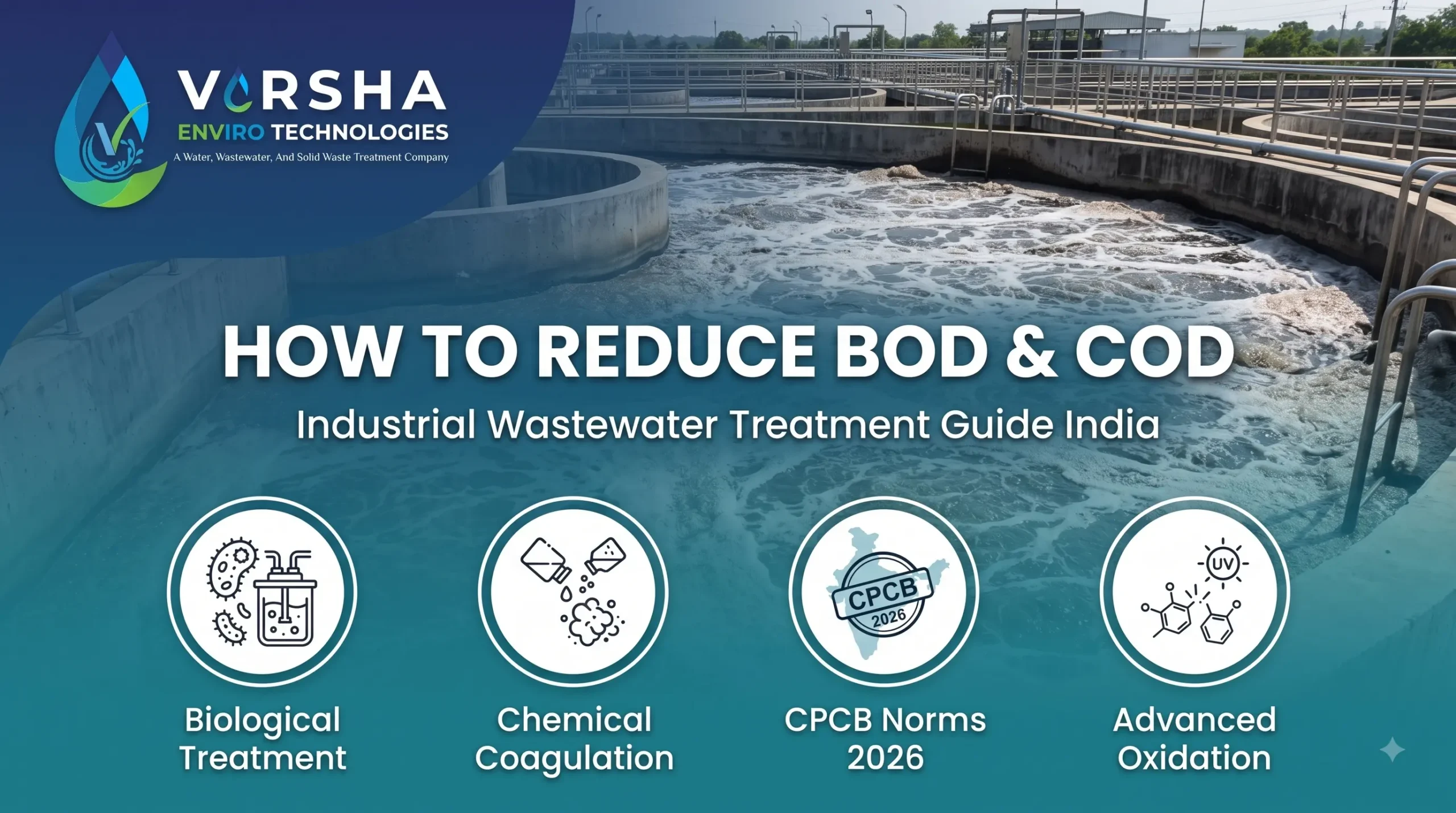
For any industry operating an Effluent Treatment Plant (ETP) in India, two parameters define compliance status more than any others: BOD (Biochemical Oxygen Demand) and COD (Chemical Oxygen Demand). If your effluent exceeds CPCB’s discharge limits — BOD ≤30 mg/L and COD ≤250 mg/L for inland surface water discharge — you’re not just underperforming, you’re in violation of the Water Act and exposed to SPCB/NGT action.
This guide breaks down what BOD and COD actually measure, why they’re elevated in industrial effluent, and the practical methods that reduce them to compliant levels.
What BOD and COD Actually Measure
BOD (Biochemical Oxygen Demand) measures the amount of oxygen microorganisms need to biologically decompose organic matter in your effluent over 5 days (BOD5) at 20°C. High BOD means high biodegradable organic content — it tells you how much organic load your biological treatment needs to handle.
COD (Chemical Oxygen Demand) measures total oxidizable organic matter — both biodegradable AND non-biodegradable — using a strong chemical oxidant. COD is always higher than BOD for the same sample.
The BOD/COD ratio is critical for treatment design:
- BOD/COD ratio >0.5: Effluent is easily biodegradable — standard biological treatment (MBBR/SBR) works well
- BOD/COD ratio 0.3-0.5: Moderately biodegradable — biological treatment with optimization
- BOD/COD ratio <0.3: Resistant to biological breakdown — chemical/physical pre-treatment or Advanced Oxidation Process needed before biological stage
Many industrial failures to meet COD limits happen because the plant was designed only for biological treatment, but the effluent’s BOD/COD ratio indicates significant non-biodegradable content that biological treatment cannot address.
Industries With the Highest BOD/COD Load
Before choosing a treatment approach, knowing your industry’s typical effluent profile matters:
| Industry | Typical COD Range | Key Treatment Challenge |
|---|---|---|
| Food processing/dairy | 80,000 – 100,000 mg/L | High organic load — excellent for biological, but high volume |
| Pharmaceutical | 10,000 – 80,000 mg/L | Complex organic molecules, often non-biodegradable, trace antibiotics |
| Textile/dyeing | 5,000 – 30,000 mg/L | High color + non-biodegradable dye compounds (low BOD/COD ratio) |
| Chemical manufacturing | 5,000 – 50,000 mg/L | Complex, often toxic effluent — inhibitory to standard biology |
| Petroleum/refining | 500 – 5,000 mg/L | Oils, greases, phenols |
Method 1: Biological Treatment (Most Common, Lowest Cost)
For effluent with a BOD/COD ratio above 0.4, biological treatment using aerobic microorganisms (MBBR, SBR, Extended Aeration) is the most cost-effective BOD/COD reduction method.
How it works: Aerobic bacteria in the treatment system consume dissolved organic matter (BOD) as a food source, oxidizing it into CO2 and water while requiring oxygen (supplied by aeration blowers). Well-operated MBBR/SBR systems routinely achieve BOD reduction of 90-95% from inlet to outlet.
Key factors affecting biological treatment efficiency:
- Dissolved Oxygen (DO) in aeration zone: Must be maintained at 2-4 mg/L continuously
- Hydraulic Retention Time (HRT): Adequate contact time between sewage and biomass
- Sludge Retention Time (SRT): Maintaining enough biomass (Mixed Liquor Suspended Solids — MLSS) in the system
- Temperature: Biological activity slows below 15°C — relevant for North Indian winters
- Toxic inhibitors: Industrial effluents with high metal concentrations, extreme pH, or chlorinated solvents can kill the biological culture
Limitation: Biological treatment does not reduce non-biodegradable COD. If your COD consistently exceeds norms even with a well-operated biological system, the remaining COD is likely non-biodegradable — requiring chemical or advanced oxidation treatment.
Method 2: Coagulation & Flocculation (Chemical BOD/COD Reduction)
Coagulation introduces chemicals (PAC, alum, ferric chloride — FeCl3) that cause dissolved and colloidal organic particles to clump together (flocculate), settling as sludge. This physically removes organic matter rather than biologically oxidizing it.
Efficiency data: FeCl3 coagulation at pH 8.5 with a dose of 0.15 g/L achieves approximately 56.7% COD removal in pilot studies on complex industrial effluent. While this is not sufficient alone to meet discharge norms from a high-load effluent, it is highly effective as a pre-treatment before biological stages — reducing the load on downstream biology and improving overall system efficiency.
When to use: Most effective for effluents with high suspended solids and colloidal organic content. Often used as primary treatment before the biological stage in ETP design.
[DAF (Dissolved Air Flotation) systems are commonly used in combination with coagulation/flocculation to physically separate the formed floc, particularly for oil and grease-heavy effluent streams from food processing and automotive industries.
Method 3: Advanced Oxidation Process (AOP) — For Non-Biodegradable COD
When biological treatment and standard coagulation cannot reduce COD to compliant levels — particularly for textile, pharmaceutical, and chemical effluent with high non-biodegradable content — Advanced Oxidation Processes (AOPs) generate highly reactive hydroxyl radicals that break down complex organic molecules that biology cannot.
Fenton Oxidation (H2O2 + iron catalyst): Among the most widely used AOPs in Indian industrial ETPs. Adding hydrogen peroxide (H2O2) with an iron catalyst (FeSO4) at acidic pH (4-5) achieves approximately 79% COD reduction in studies on textile/tannery effluent. Cost is higher than biological treatment but significantly lower than alternatives like ozonation.
Other AOP options:
- Ozone treatment: Effective for color removal and COD reduction in textile effluent, but higher energy cost
- UV/H2O2: UV light + hydrogen peroxide — effective for specific pharmaceutical and chemical compounds
- Electrocoagulation: Electrical current generates coagulants in-situ — effective for complex industrial effluent
Typical application: AOP as a tertiary polishing stage after biological treatment — reducing residual non-biodegradable COD from 400-800 mg/L (post-biology) to below 250 mg/L (CPCB limit) before discharge.
Method 4: Membrane Filtration + ZLD (For Zero Discharge Requirements)
For industries facing ZLD mandates (textile, pharma, tannery, distillery), Reverse Osmosis as a final concentration stage reduces final effluent COD near-zero by physically excluding dissolved organics — while the concentrated reject is sent for thermal evaporation. See our ZLD plant solutions guide for a detailed breakdown of when and how ZLD is required.
The Operational Factor — Often More Important Than Plant Design
Here’s what most treatment guides don’t say clearly: in many Indian industrial ETPs that consistently fail BOD/COD norms, the problem isn’t the plant design — it’s operations:
- Biological culture is periodically “shocked” by sudden pH swings, toxic batch discharges, or hydraulic overloading
- Aeration is inadequate (DO below 1 mg/L) due to blower underperformance
- Sludge recirculation ratio is not maintained
- No effluent monitoring — problems go undetected until compliance testing
If your ETP is underperforming on BOD/COD, an operational audit by a qualified engineer is often more effective (and less expensive) than equipment upgrades. Our AMC and repair team conducts operational audits and effluent quality diagnostics as part of our service offering.
CPCB Discharge Standards Reference (2026)
| Parameter | Inland Surface Water | Public Sewer | Land Irrigation |
|---|---|---|---|
| BOD (5-day, 20°C) | ≤30 mg/L | ≤350 mg/L | ≤100 mg/L |
| COD | ≤250 mg/L | — | — |
| TSS | ≤100 mg/L | ≤600 mg/L | ≤200 mg/L |
| pH | 6.5–9.0 | 5.5–9.0 | 5.5–9.0 |
| Oil & Grease | ≤10 mg/L | ≤20 mg/L | ≤10 mg/L |
Frequently Asked Questions
Q: My ETP is running but COD is still above 250 mg/L. What’s wrong? A: The most common causes: (1) Non-biodegradable COD in your effluent that biological treatment cannot address — check your BOD/COD ratio; (2) Biological culture is stressed or damaged — check DO levels, MLSS, and for any toxic/pH shock events; (3) Hydraulic overloading — plant capacity is exceeded. An operational audit identifies the root cause.
Q: Can BOD be high even if the plant looks clean and running? A: Yes — an STP can appear operationally normal while biological treatment is degraded, producing effluent with elevated BOD. Visual inspection is not a substitute for effluent quality testing.
Q: Is there a quick fix for COD compliance before an inspection? A: Chemical dosing (coagulation + oxidation) can provide short-term COD reduction, but it’s not a substitute for proper biological treatment. Consistent compliance requires a properly designed and operated system, not spot treatments.
Q: How often should we test our effluent for BOD/COD? A: Monthly in-house testing is recommended as a minimum operational practice. Quarterly certified lab testing is typically required for regulatory compliance reporting under your Consent to Operate.
Final Thoughts
Reducing BOD and COD in industrial wastewater requires understanding your effluent’s specific characteristics first — particularly the BOD/COD ratio, which determines whether biological treatment alone is sufficient or whether chemical/AOP stages are needed. Most industrial compliance failures are not design problems — they’re operational. Getting your effluent characterized, auditing your existing system’s operation, and addressing the root cause is more effective than adding equipment blindly.
Need a BOD/COD compliance audit or ETP upgrade assessment? Speak with our team for a technical evaluation.