

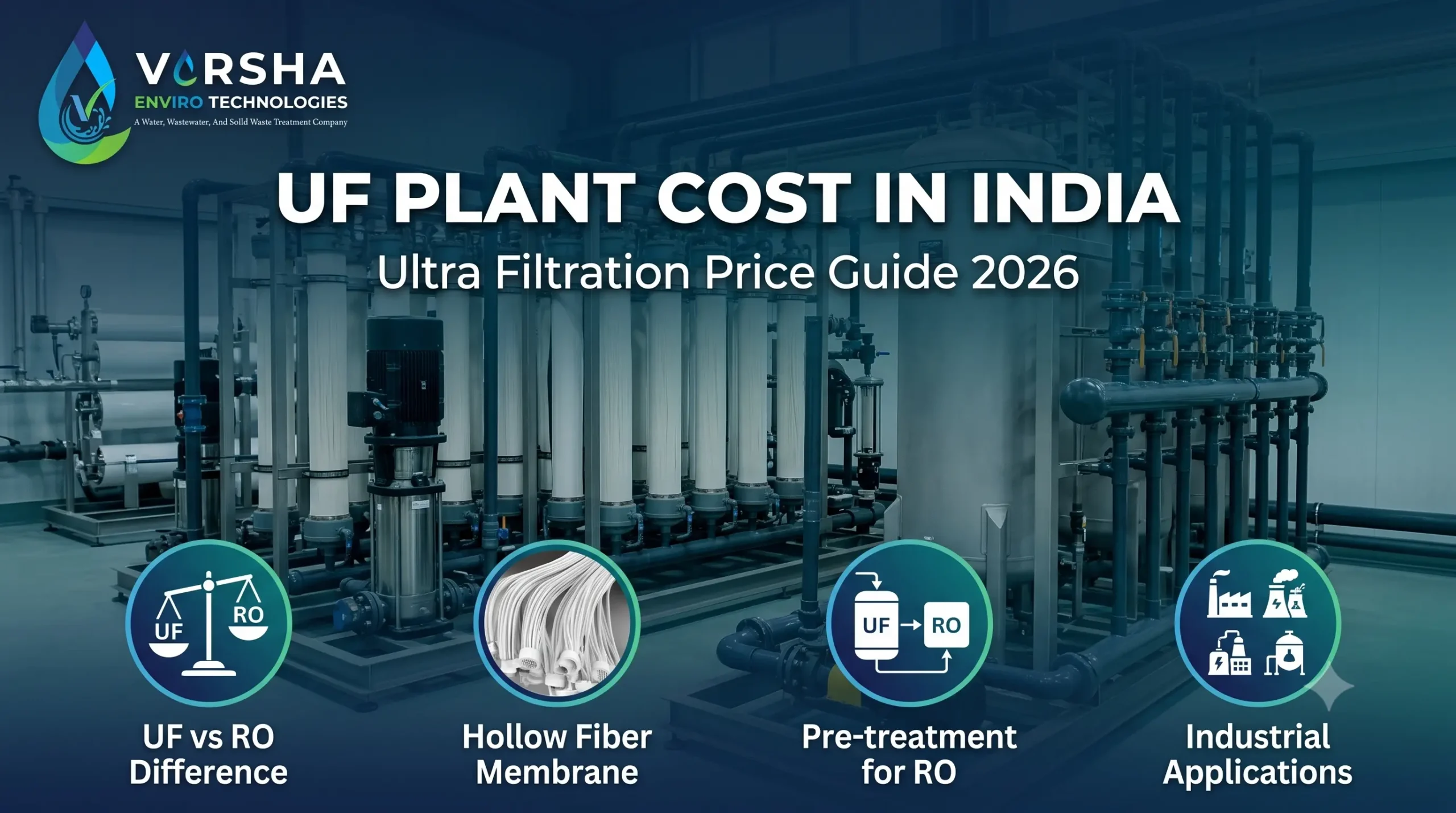
Ultra Filtration (UF) plants occupy a specific and valuable niche in India’s water treatment landscape — they remove bacteria, viruses, and suspended solids with far less energy than RO, while also serving as the most effective pre-treatment stage before RO membranes. Yet UF is often the least well-understood technology among buyers who default to comparing only RO plants and softeners. Here’s a clear, cost-focused guide for 2026.
What Exactly Does a UF Plant Remove?
UF membranes have a pore size of 0.01-0.1 micron — small enough to physically block:
- Bacteria (0.2-2 micron) — 100% removal
- Viruses (0.02-0.2 micron) — near-complete removal
- Suspended solids and turbidity
- Colloidal particles
- Some larger organic molecules
What UF does NOT remove:
- Dissolved salts and minerals (TDS)
- Small dissolved organics and chemicals
- Heavy metal ions (unless they’re in particulate form)
This is the critical distinction: UF produces microbiologically safe water but does not reduce TDS. If TDS reduction is needed, RO is required — often with UF as pre-treatment. Where only microbial safety and clarity are needed (surface water treatment, industrial process water, pre-treatment for other systems), UF alone is often sufficient.
UF vs. RO — When Do You Need Each?
| Need | Better Choice |
|---|---|
| Remove bacteria and viruses, maintain TDS | UF |
| Reduce TDS, remove dissolved salts | RO |
| Pre-treat surface/bore water before RO | UF (protects RO membranes) |
| Drinking water from municipal supply | UF (if TDS is acceptable) |
| High TDS bore well water for drinking | UF + RO in series |
| Industrial process water (medium purity) | UF or UF + softener |
How a UF Plant Works
- Feed water enters the membrane module (typically hollow fiber configuration for industrial scale)
- Pressure is applied (2-5 bar — much lower than RO’s 15-40 bar, which directly translates to lower energy consumption)
- Water permeates through the hollow fiber membrane pores, leaving bacteria, viruses, and suspended particles behind
- Permeate (clean water) exits for use or next treatment stage
- Periodic backwash — at regular intervals (typically every 20-45 minutes), clean water is pushed backward through the membrane to dislodge accumulated particles, maintaining flux rate and extending membrane life
UF membranes are self-cleaning in this way — unlike cartridge filters that require manual replacement, UF systems backwash automatically and continuously.
UF Plant Cost by Capacity (2026)
| Capacity | Approx. Price Range | Typical Application |
|---|---|---|
| Small UF units (100-500 LPH) | ₹50,000 – 2 lakhs | Small commercial, institutional pre-treatment |
| Mid-size UF systems (1,000-5,000 LPH) | ₹2 – 8 lakhs | Industrial pre-treatment, medium commercial |
| Large UF plants (10,000-50,000 LPH) | ₹8 – 30 lakhs | Municipal, large industrial, pre-RO protection |
| Very large-scale UF (100 m³/hr+) | ₹25 lakhs – several crore | Large water treatment plants, municipal schemes |
Pricing covers membrane modules, feed pump, backwash system, and control panel. Civil, piping, and installation are additional. Membrane element cost and replacement frequency are key long-term cost factors.
What Drives UF Plant Cost
1. Membrane Configuration
- Hollow Fiber (HF): Most common for industrial and municipal applications in India. High packing density (more membrane area per vessel volume), efficient backwashing. Used by most reputable UF plant manufacturers.
- Spiral Wound: Less common for UF in India; more typical for RO applications.
- Ceramic membranes: Higher cost, much longer life, used in harsh chemical environments.
2. Recovery Rate UF systems typically achieve 85-95% recovery (compared to RO’s 60-75%) — meaning less feed water is wasted as concentrate. This makes UF more water-efficient than RO, which is a meaningful operating cost advantage in water-scarce industrial locations.
3. Membrane Life and Replacement Cost UF membrane modules typically last 3-7 years with proper operation and regular backwash cycles. Chemical cleaning (CIP — Clean-in-Place) with acid or alkaline solutions is required periodically to restore flux when backwashing alone is insufficient. Membrane replacement is the primary long-term capital expense.
4. Pre-treatment Requirement UF systems handle moderate turbidity and suspended solids loads — but very high turbidity (muddy river water, heavily contaminated bore well water) may require a coagulation/flocculation + sedimentation stage before UF, adding to system cost. For typical bore well or municipal feed water, UF can usually be installed directly.
Why UF as Pre-treatment for RO Is Worth the Investment
One of the most cost-effective applications of UF in Indian industry is as pre-treatment before RO plants. Here’s why:
- RO membranes are expensive (₹5,500-8,000+ per element)
- Bacteria, colloidal particles, and organic matter in feed water foul RO membranes — shortening their life from the typical 2-3 years down to months in severe cases
- A properly sized UF system ahead of the RO removes virtually all fouling agents — extending RO membrane life and reducing replacement frequency
- The total cost of ownership of an RO + UF system is often lower than an RO-only system with high membrane replacement frequency, especially for turbid or microbiologically challenging feed water sources
Varsha Enviro’s UF plant systems are available in hollow fiber configuration for standalone water treatment and pre-treatment applications, complementing our RO plant systems for comprehensive water treatment solutions across Delhi NCR, Haryana, and Jaipur.
Where UF Plants Are Used in India
- Drinking water: Municipal water treatment for towns and peri-urban areas; housing society point-of-use treatment where TDS is acceptable but microbial safety is the concern
- Industrial pre-treatment: Protecting RO membranes in textile, pharma, food & beverage, and industrial process water systems
- Food & beverage: Clarification of juices, dairy processing, fermentation filtration — where microbial safety and clarity are needed without the high pressure and salt rejection of RO
- Pharmaceutical: Pre-treatment before RO and DM systems in water purification trains
- Hospital and healthcare: Point-of-use water treatment for dialysis pre-treatment, laboratory water
Frequently Asked Questions
Q: Does a UF plant remove TDS from water? A: No. UF removes bacteria, viruses, and suspended particles, but dissolved salts pass through UF membranes. For TDS reduction, [our RO plant systems] is required — often with UF as pre-treatment.
Q: How energy-efficient is UF compared to RO? A: Significantly more efficient. UF operates at 2-5 bar pressure vs. RO’s 15-40 bar, consuming roughly 3-5x less electricity per cubic metre of treated water for the filtration stage. This makes UF an attractive choice wherever TDS reduction is not required.
Q: How often does a UF membrane need replacement? A: With proper operation, backwash cycles, and periodic chemical cleaning, UF membrane modules typically last 3-7 years. Membrane life is extended by ensuring proper pre-treatment and avoiding extended chemical exposure outside of controlled CIP protocols.
Q: Can UF water be used for drinking without RO? A: If the source water’s TDS is within acceptable limits (as per IS 10500 — typically below 500 mg/L for drinking), UF-treated water is microbiologically safe and can be suitable for drinking. Where TDS is high, RO is needed after UF for full water quality compliance.
Q: Is a UF plant suitable for hard water treatment? A: UF alone does not remove hardness (dissolved calcium/magnesium). For hard water, a softener or RO is needed for hardness removal — UF can be used as pre-treatment alongside these technologies as part of a complete water treatment solutions train.
Final Thoughts
UF plant cost in India scales from ₹50,000 for small units to crore-scale for large municipal or industrial applications — with a significantly lower operating cost than RO due to lower operating pressure. The key decision points: whether your application requires TDS reduction (if yes, RO is needed; UF can be pre-treatment), and whether your feed water has turbidity or microbial quality issues that would foul RO membranes without a UF protection stage.
Need a UF plant sized for your water source and application? Contact our team for a no-obligation technical assessment.