
If your facility’s wastewater carries heavy oil, grease, or fat content — common in food processing, dairy, meat processing, or automotive/metal units — a biological treatment stage alone usually isn’t enough. A Dissolved Air Flotation (DAF) system is typically the answer, and it’s one of the most cost-effective pre-treatment investments available for FOG-heavy effluent.
How a DAF System Actually Works
- Pressurization — A portion of clarified water is saturated with air under pressure
- Release into the flotation tank — The pressure drop releases millions of microscopic air bubbles (the full air-saturation cycle typically takes around 10-15 seconds in well-designed systems)
- Bubble attachment — These bubbles attach to oil droplets, grease, and fine suspended solids
- Flotation — The bubble-particle combination rises to form a froth/scum layer on the surface
- Skimming — A mechanical skimmer continuously removes this layer
- Clarified water outlet — Treated water exits for further treatment or discharge
Coagulant and flocculant chemicals are commonly dosed before the DAF stage to improve particle aggregation and flotation efficiency — though some lower-FOG applications can run on physical flotation alone.
DAF System Cost in India — Real Price Points
Based on current market listings for industrial DAF units in India:
| System Type | Approx. Price Range |
|---|---|
| Entry-level/compact DAF units (small capacity, mild steel) | ₹2.5 – 4 lakhs |
| Mid-capacity automatic DAF units | ₹5 – 7.5 lakhs |
| Large-capacity / fully automated / stainless steel construction | Significantly higher — depends on flow rate (m³/hr), automation, and chemical dosing integration |
Key cost drivers:
- Flow rate (measured in m³/hr or KLD) — systems are available from roughly 1 m³/hr up to 1000+ m³/hr in a single unit
- Material of construction — mild steel (lower cost) vs. stainless steel 304/316 (higher cost, better for corrosive/high-FOG environments and longer service life)
- Automation level — manual skimming vs. fully automatic level control and dosing
- Chemical dosing system — automated coagulant/flocculant dosing adds to both capital and ongoing cost
Removal Efficiency — What You’re Actually Paying For
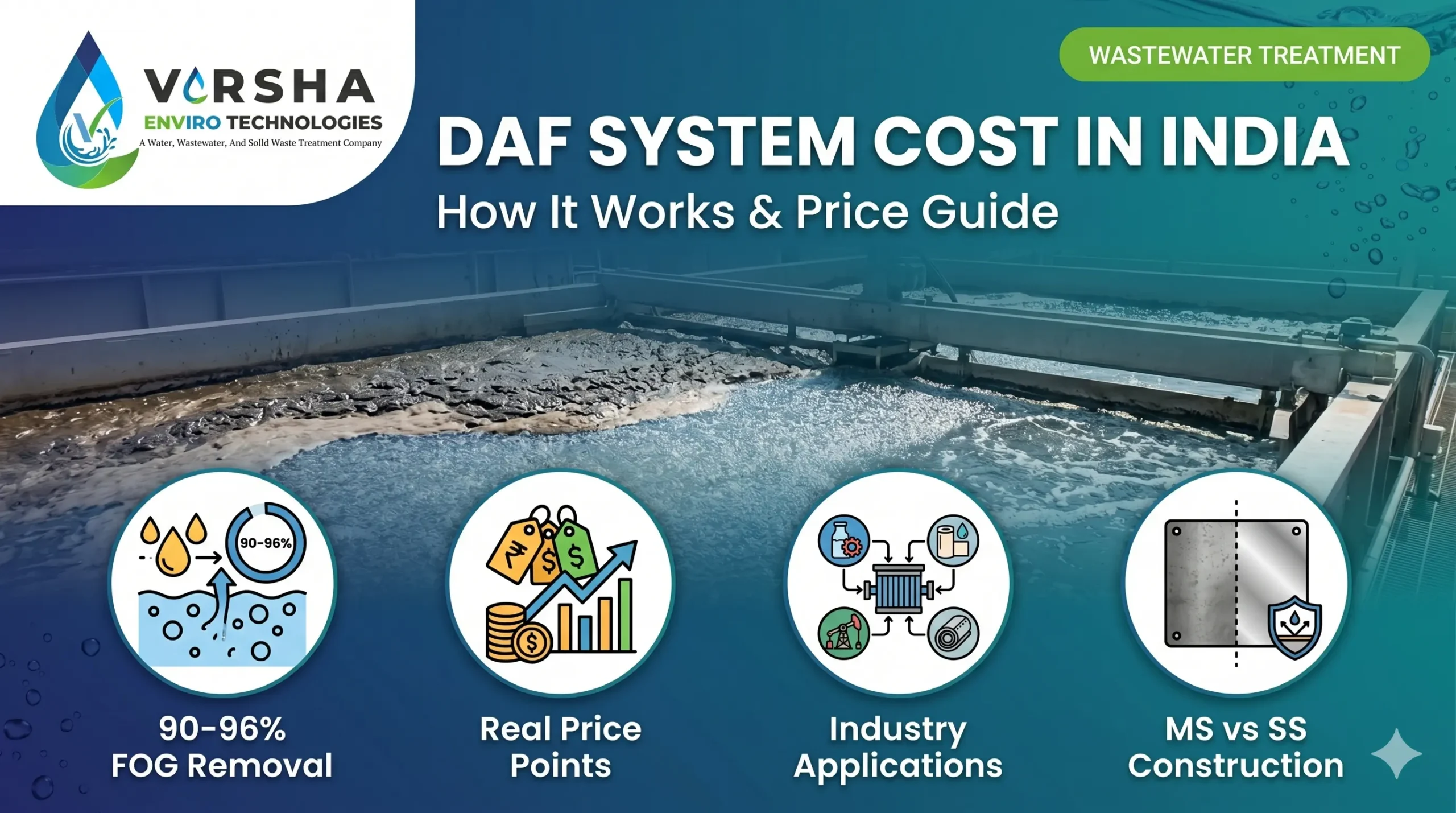
Modern DAF systems are designed to remove 90-96% of suspended solids and fats, oils, and grease (FOG) from industrial wastewater. This level of removal matters because oil and grease that bypasses pre-treatment can:
- Coat biological treatment media, cutting downstream MBBR/SBR efficiency
- Cause foaming and operational disruptions in aeration tanks
- Increase sludge handling complexity and disposal costs downstream
DAF sludge typically has around 7% dry solids content — when left untreated, this adds significant disposal cost due to the high water content, which is why a downstream dewatering/filter press setup is usually recommended alongside the DAF unit itself.
Where DAF Systems Are Used
- Food processing & dairy — fat and protein-heavy wastewater
- Meat & poultry processing — blood, fat, organic solids
- Edible oil refineries
- Automotive & metal processing — oily wastewater from machining/washing operations
- Textile & chemical units — as pre-treatment before biological treatment
- CETPs — where incoming effluent has variable, unpredictable oil/grease content from multiple member units
DAF vs. Conventional Clarifier — What’s the Difference?
A conventional clarifier relies on gravity settling of heavier-than-water solids. DAF works in the opposite direction — using air bubbles to float lighter materials (oil, grease, fine solids) to the surface for skimming. This makes DAF significantly more effective than gravity settling for FOG-heavy effluent, where conventional clarifiers often struggle.
Notably, some advanced DAF designs can handle TSS loads above 2,000 mg/L without choking — a level that would overwhelm standard clarification approaches.
Choosing the Right DAF System
- Get your effluent’s oil/grease and TSS load characterized before accepting a design quote
- Ask whether the vendor offers pilot testing for your specific effluent stream
- Confirm the chemical dosing system is properly sized for your actual load, not a generic default
- Check material of construction — if your effluent is corrosive or continuously high-FOG, stainless steel pays for itself over the plant’s life despite higher upfront cost
- Ask about AMC support specifically for the skimmer mechanism, which is the highest-wear component
Varsha Enviro’s DAF systems are designed for food processing, automotive, and industrial effluent streams with high oil/grease content, and integrate directly with our ETP solutions for complete treatment.
Frequently Asked Questions
Q: Can a DAF system replace biological treatment entirely? A: No. DAF is a pre-treatment or primary treatment stage. It’s almost always followed by biological treatment (MBBR/SBR) to address dissolved organic load that flotation alone cannot remove.
Q: Does every DAF installation need chemical dosing? A: Not always — some lower-FOG applications work on physical flotation alone — but most industrial applications see significantly better removal efficiency with coagulant/flocculant dosing.
Q: How often does skimmed sludge need removal? A: This depends entirely on your effluent’s oil/grease load. High-FOG industries like meat processing need far more frequent sludge removal than lower-load industries like general manufacturing.
Q: Is stainless steel construction worth the extra cost? A: For continuously high-FOG or corrosive effluent streams, yes — SS 304/316 construction significantly extends service life and reduces maintenance frequency compared to mild steel, often justifying the higher upfront cost within a few years.
Q: Can a DAF system be added to an existing ETP that’s underperforming? A: Yes — adding a DAF pre-treatment stage to an existing ETP that’s struggling with oil/grease-related fouling is a common and cost-effective upgrade, often more economical than a full plant overhaul.
Final Thoughts
For any facility dealing with oil, grease, or fat-heavy wastewater, a DAF system is usually the difference between a biological treatment plant that performs reliably and one that constantly struggles with foaming and inefficiency. Getting your effluent properly characterized before choosing a DAF specification is the single most important step — and the one most low-cost vendors skip.
Want to know if a DAF system is right for your facility? Speak with our team for an assessment based on your actual effluent profile.