
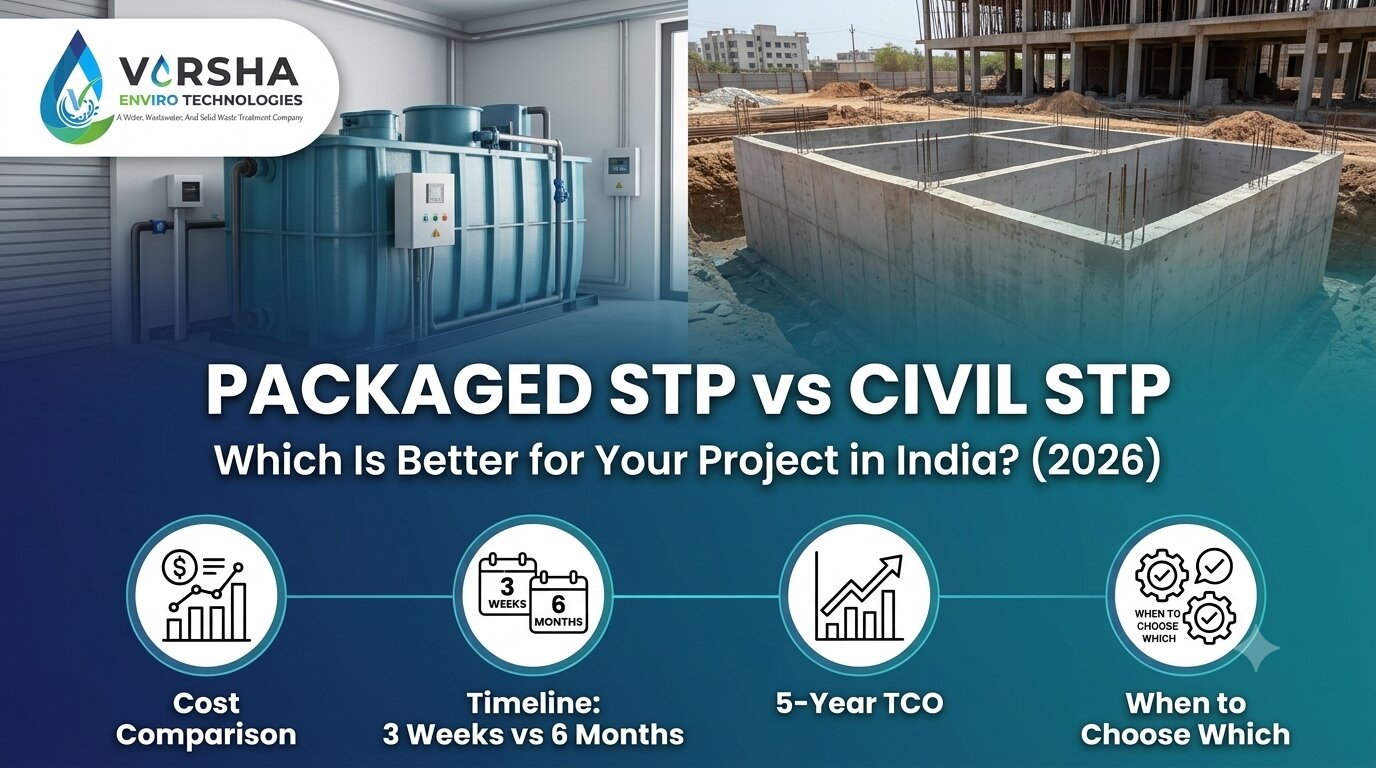
When comparing STP quotations in India, buyers frequently encounter two fundamentally different approaches: a packaged (pre-fabricated FRP) unit or a conventional civil (RCC tank-based) plant. The packaged option typically looks more expensive per KLD. The civil option looks cheaper on paper but comes with a contractor, a 3-6 month timeline, and a civil scope that’s hard to compare accurately across vendors.
This guide cuts through the confusion with a direct comparison on the factors that actually matter for most projects.
What Each System Actually Is
Packaged STP (FRP/Prefabricated): A complete sewage treatment plant factory-built into FRP (Fiberglass Reinforced Plastic) or fabricated steel modules. The treatment stages — equalization, biological treatment, secondary clarification — are contained in compact modular vessels that arrive at site pre-fabricated. Civil work required: only a small foundation plinth or base slab.
Civil STP (RCC/Conventional): Treatment tanks are built on-site using RCC (Reinforced Cement Concrete) construction — poured concrete walls, shuttering, rebar. Larger footprint, longer construction timeline, but higher structural durability and typically preferred for capacities above 500 KLD.
Head-to-Head Comparison
| Factor | Packaged STP | Civil STP |
|---|---|---|
| Per-KLD cost (equipment) | ₹45,000 – 1,10,000/KLD | ₹20,000 – 35,000/KLD (equipment only) |
| Civil work cost | Minimal — small foundation only (₹1,000–3,000/KLD) | High — full RCC construction (₹8,000–18,000/KLD) |
| Total installed cost | Often similar on 5-year TCO basis | Higher total when civils included |
| Installation timeline | 3–6 weeks from order to commissioning | 3–6 months (RCC curing = 21–28 days per pour) |
| Space required (50 KLD) | 150 – 250 sq ft | 400 – 800 sq ft |
| Underground option | Limited — requires waterproofed RCC pit even for FRP | Yes — fully underground possible |
| Structural lifespan | 15–20 years (FRP degrades slower than RCC in sewage environment) | 25–30 years (RCC with proper waterproofing) |
| H₂S corrosion resistance | Excellent (FRP not affected by hydrogen sulfide) | Moderate (H₂S corrodes concrete and rebar over time) |
| Scalability | Modular — add another unit to expand | Fixed — expansion requires concrete breaking |
| Automation level | Typically higher — factory-set controls | Variable — depends on contractor |
| OC deadline pressure | Best choice | High risk of construction delay |
| Basement installation | Yes — units can be installed in basement mechanical room | Not practical |
| Relocation | Possible in some cases | Not possible |
| Capacity above 500 KLD | Less common — multiple units or hybrid | Preferred and more economical |
The 5-Year TCO Reality — Why Packaged Wins for Most Projects Under 500 KLD
The packaged STP “looks” more expensive because buyers compare only the per-KLD equipment cost. The complete picture:
50 KLD example, 5-year total cost of ownership:
| Cost Component | Packaged STP | Civil STP |
|---|---|---|
| Equipment | ₹22 – 35 lakhs | ₹12 – 18 lakhs |
| Civil construction | ₹1 – 3 lakhs (foundation only) | ₹10 – 18 lakhs (RCC tanks) |
| Electrical + piping | ₹3 – 5 lakhs | ₹3 – 5 lakhs |
| Commissioning | ₹1 lakh | ₹1 – 2 lakhs |
| Total initial investment | ₹27 – 44 lakhs | ₹26 – 43 lakhs |
| AMC × 5 years | ₹9 – 15 lakhs | ₹9 – 15 lakhs |
| 5-year TCO (approximate) | ₹36 – 59 lakhs | ₹35 – 58 lakhs |
On a 5-year TCO basis, the two approaches are roughly comparable for mid-size projects — but the packaged option delivers 3–6 months faster, requires 40–60% less space, and eliminates the construction coordination risk that civil STP projects routinely face.
The OC timeline risk is real: Multiple housing projects have faced OC delays because the civil STP contractor hit monsoon delays, labour issues, or RCC curing extensions. A packaged STP ordered and commissioned in 4 weeks is immune to this risk.
When Civil STP Is the Right Choice
Civil construction becomes the better option in specific situations:
1. Capacity above 500 KLD: At large scale, civil RCC construction offers better per-KLD economics than multiple packaged modules. Municipal, large industrial, and large township projects (500 KLD+) are typically better served by civil design.
2. Fully underground installation is required: Some residential projects prefer a fully underground STP with a park or car park above. This requires RCC tank construction — FRP modules cannot be buried directly in soil for extended periods without additional structural protection.
3. Very long design life required (30+ years): Properly constructed and waterproofed RCC tanks in non-corrosive environments can last 30+ years. Packaged FRP units are rated for 15–20 years.
4. Significant site-specific customization needed: Complex sites with unusual dimensions, non-standard flow configurations, or integration with existing civil infrastructure may suit a civil design better than standardized packaged modules.
The Hidden Cost of Civil STP: H₂S Concrete Corrosion
One factor consistently underestimated in civil STP economics: hydrogen sulfide (H₂S) corrosion. Anaerobic zones in STP tanks generate H₂S gas, which attacks concrete and rebar. Over 10–15 years, concrete corrosion in untreated civil STP tanks is a well-documented problem across India — requiring expensive structural repairs that packaged FRP systems simply don’t face. FRP is inherently resistant to H₂S.
Practical Decision Guide
| Your Situation | Choose |
|---|---|
| OC deadline pressure, need STP fast | ✅ Packaged |
| Basement / rooftop / space-constrained installation | ✅ Packaged |
| Project capacity below 300 KLD | ✅ Packaged (better TCO) |
| Capacity above 500 KLD | ✅ Civil |
| Fully underground, park/car park above | ✅ Civil |
| Budget is tight, can absorb construction delay | Civil (lower equipment cost, but verify civil scope carefully) |
| Replacing non-functional existing civil STP | Consider packaged module inside existing civils |
Varsha Enviro’s STP plant solutions are available in both packaged FRP configurations and civil designs — technology and configuration recommendation is always based on your specific site constraints, capacity, timeline, and budget. For a complete cost understanding across capacity ranges, see our STP plant cost guide.
Frequently Asked Questions
Q: Does a packaged STP perform as well as a civil STP? A: Yes — the treatment technology (MBBR, SBR) performs identically regardless of whether the vessel is FRP or RCC. The vessel material affects structural durability and space efficiency, not biological treatment performance.
Q: Can I install a packaged STP underground? A: Some packaged units can be installed in below-grade utility rooms or basement mechanical spaces. Fully buried (with soil above) is possible but requires a protective RCC pit around the FRP unit — essentially a hybrid approach. Consult your manufacturer about underground installation requirements before specifying.
Q: What is the installation process for a packaged STP? A: Typically: site preparation and foundation casting (3–5 days), delivery and crane placement of modules, piping and electrical connections (5–10 days), biological culture seeding and commissioning (2–4 weeks for culture establishment). From factory dispatch to functional plant: usually 4–6 weeks.
Q: My existing civil STP is failing — should I repair it or replace it with a packaged unit? A: If the existing civil structure is sound but the equipment inside is degraded or the technology is outdated, one option is retrofitting — installing new MBBR media and equipment into the existing civil tank. This can be more cost-effective than either full civil reconstruction or a new packaged unit. A site inspection determines which option makes sense for your specific plant.
Q: Which has lower maintenance cost? A: Generally similar. Packaged FRP units tend to have slightly lower civil maintenance costs (no concrete repair, no waterproofing re-application). Civil STPs may have lower mechanical maintenance costs at large scale due to more standard industrial components. For typical 25–200 KLD projects, the difference in AMC cost is not significant.
Final Thoughts
For most housing societies, hotels, hospitals, institutions, and industrial facilities below 500 KLD, packaged STPs offer a compelling combination of faster timeline, lower total installed cost, smaller footprint, and inherently better H₂S resistance — at equipment prices that are only slightly higher than civil alternatives before civil construction cost is included. The civil STP’s place is in large-scale and fully-underground projects where its structural advantages justify the construction timeline and complexity. Contact Varsha Enviro for a site-specific recommendation on which approach fits your project.