
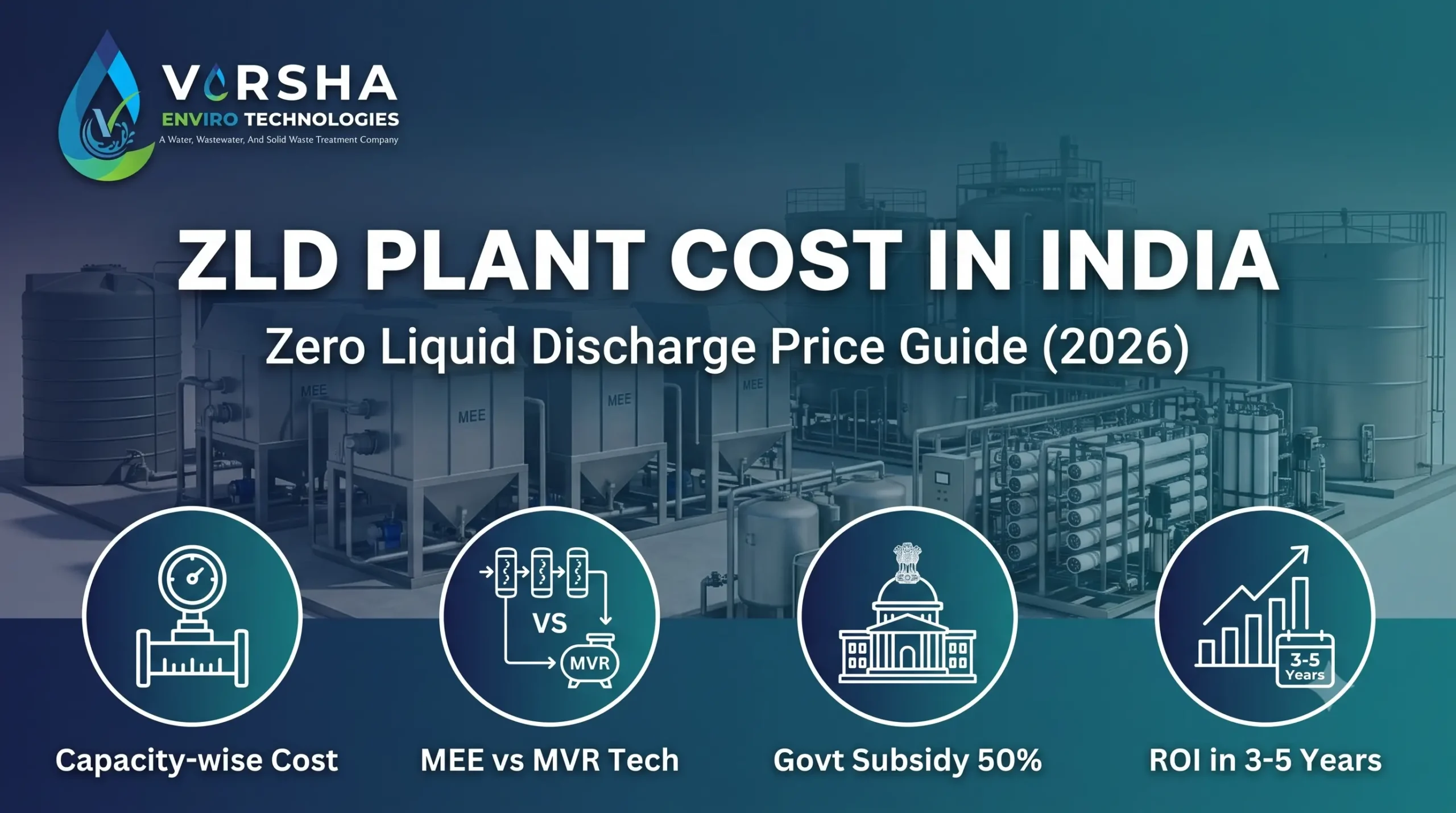
Zero Liquid Discharge (ZLD) is one of the most capital-intensive investments in industrial water treatment — but for industries facing mandatory compliance, it’s also unavoidable. If you want to understand what ZLD is and how it works, we’ve covered that separately. This guide focuses specifically on what a ZLD plant actually costs in India in 2026, capacity-wise, and how to evaluate whether the investment makes financial sense for your facility.
Why ZLD Cost Is So Much Higher Than Conventional Treatment
A standard ETP treats effluent to meet discharge norms — it still releases treated water into the environment. A ZLD system goes further: it recovers 95-98% of water from that treated effluent, leaving only a solid waste (salt cake or dry solids) that is separately disposed of. This near-total water recovery requires advanced, energy-intensive technology — which is the primary reason ZLD costs 4-5x more than conventional treatment systems of the same capacity.
The technology stack in a ZLD plant typically includes:
- Pre-treatment (ETP/RO pre-treatment)
- Reverse Osmosis (primary concentration)
- Multiple Effect Evaporator (MEE) or Mechanical Vapour Recompression (MVR)
- Agitated Thin Film Dryer (ATFD) or Crystallizer (for final solids recovery)
Each of these components carries significant capital cost, and the combination of membrane + thermal technology drives both the upfront investment and the ongoing energy bill.
ZLD Plant Cost by Capacity (2026)
| Capacity | Approx. Capital Cost | Typical Application |
|---|---|---|
| Small ZLD (up to 25 KLD) | ₹10 – 25 lakhs | Small hotels, hospitals, boutique manufacturing |
| Medium ZLD (25 – 100 KLD) | ₹25 lakh – 1.5 crore | Mid-size textile, pharma, chemical units |
| 50 KLD ZLD system | ~₹30 lakh (entry) | Textile/dyeing unit cluster |
| 100 KLD ZLD system | ₹1 – 1.5 crore | Standard industrial facility |
| Large industrial ZLD (100+ KLD) | ₹1 crore and above | Large manufacturing plants |
| 1 MLD (1000 KLD) ZLD system | ₹6 – 12 crore+ | Large industrial complexes, pharmaceutical campuses |
Capital cost excludes civil work (tanks, foundations), land, and grid power infrastructure, which can add significantly in greenfield installations.
MEE vs. MVR — Technology Choice Affects Cost Significantly
The evaporation technology you choose has a major impact on both capital and operating cost:
| Technology | Capital Cost | Energy Consumption | Best For |
|---|---|---|---|
| MEE (Multiple Effect Evaporator) | Lower | Higher (steam/heat driven) | Facilities with cheap steam availability (e.g., co-located boiler) |
| MVR (Mechanical Vapour Recompression) | Higher | Lower (electricity driven, more efficient) | Facilities without steam; long-term energy saving priority |
For most Indian industrial facilities without a dedicated steam plant, MVR-based ZLD tends to offer better long-term economics despite the higher upfront cost — primarily because the Indian industrial electricity tariff for MVR compressor operation is often more economical than operating a separate steam boiler for MEE.
Energy Cost — The Often-Underestimated Operating Expense
ZLD’s biggest ongoing cost is energy. Where a conventional ETP or STP uses roughly 0.5-1.5 kWh per cubic metre of treated water, a full ZLD system uses 80-100 kWh per cubic metre due to the thermal evaporation stages. For a 100 KLD ZLD plant running continuously, this translates to significant monthly electricity bills that must be factored into the total cost of ownership — not just the capital cost.
This energy gap is why ZLD makes financial sense primarily where:
- Compliance mandates leave no alternative (regulatory compulsion)
- Water scarcity makes treated water reuse financially valuable
- The facility can recover/sell valuable byproducts (e.g., salt recovery from textile effluent)
Which Industries Must Have ZLD in India?
Government mandates ZLD compliance for specific high-pollution sectors. Currently, ZLD is mandatory (CPCB/SPCB directive) for:
- Textile dyeing and processing
- Pharmaceutical manufacturing
- Tanneries
- Distilleries
- Sugar industries (in some states)
- Chemical and dye manufacturing
For these industries, ZLD is not an optional investment — it is a compliance requirement. Operating without ZLD after a closure notice exposes the facility to plant shutdown, pollution penalties, and legal action.
Government Subsidies and Support
Industries facing ZLD compliance requirements may be eligible for central government support under the Industrial Pollution Control scheme (IPDS), which provides grants covering up to 50% of project costs, with a maximum subsidy cap of ₹75 crore per project. State-specific schemes also exist in some industrial cluster-heavy states. Checking with your State Pollution Control Board and the Ministry of Environment, Forest and Climate Change before finalizing your ZLD project budget is worth the time — grant availability can materially change the financial case.
ZLD ROI — When Does It Pay Back?
Despite high upfront costs, ZLD delivers measurable financial return:
- Water savings: 95-98% of treated water is recovered for reuse. For water-intensive industries paying ₹50-150 per KL for fresh water, this reuse value compounds quickly at scale
- Regulatory risk reduction: Avoiding closure notices and penalties has real financial value that is easy to underestimate until it’s relevant
- Byproduct recovery: Salt, minerals, or other concentrated byproducts recovered through crystallization can be sold or reused in the manufacturing process in some industries
- ROI timeline: Studies across Indian ZLD installations show payback periods of 3-5 years through combined water savings and byproduct recovery
ZLD systems require ₹1-1.5 crore initial investment for 100 KLD capacity — higher than conventional treatment, but the long-term economics are fundamentally different once you factor in regulatory compliance certainty and water recovery value.
How to Choose a ZLD Technology Partner
The complexity of ZLD integration makes vendor selection critical. Key checkpoints:
- Ask for your effluent characterization before they design anything — TDS, COD, specific ions (sulfates, chlorides, heavy metals) all affect MEE/MVR design
- Confirm whether RO pre-concentration stage is included and properly sized (this reduces thermal evaporation load significantly, cutting operating cost)
- Check their track record with your specific industry — textile ZLD and pharmaceutical ZLD have very different design requirements
- Confirm CPCB/SPCB compliance documentation support for your sector-specific norms
- Ask about AMC and long-term operation support — ZLD systems are complex and require skilled operation, not just basic maintenance
Varsha Enviro’s ZLD plant solutions are designed using MEE/MVR/ATFD technology combinations matched to industry-specific effluent profiles, from textile clusters to pharmaceutical facilities, across Delhi NCR, Haryana, and Jaipur.
Frequently Asked Questions
Q: What is the difference between ZLD and MLD (Minimal Liquid Discharge)? A: ZLD recovers nearly 100% of water from wastewater, leaving only solid residue. MLD allows controlled, partial liquid discharge after treatment. ZLD is more expensive and energy-intensive, but required where regulators mandate zero liquid discharge compliance.
Q: Is ZLD mandatory for all industries in India? A: No — ZLD mandate is currently specific to high-pollution sectors (textile dyeing, pharma, tanneries, distilleries, certain chemical industries). Other industries may use conventional ETP treatment with discharge to the environment. See our full breakdown of ETP solutions for non-ZLD compliance options.
Q: Can an existing ETP be upgraded to ZLD? A: Often yes — adding RO concentration and MEE/MVR evaporation stages to a well-performing conventional ETP is generally more cost-effective than building a complete ZLD system from scratch, provided the existing pre-treatment meets ZLD feed water quality requirements.
Q: What happens to the solid waste from a ZLD crystallizer? A: The solid cake produced (typically salt or a mixed mineral solid depending on effluent composition) must be disposed of as per applicable Hazardous Waste Management Rules, or in some cases (e.g., textile salt recovery) can be reused in the production process.
Q: How long does ZLD plant commissioning take? A: A typical industrial ZLD project takes 6-18 months from order to commissioning, depending on scale and site readiness. Trial runs are essential before claiming compliance.
Final Thoughts
ZLD plant cost in India is genuinely high — but for sectors facing mandatory compliance, the question isn’t whether to invest, it’s how to structure the investment to minimize total cost of ownership while meeting regulatory timelines. Getting your effluent properly characterized, evaluating MEE vs. MVR based on your energy economics, and checking subsidy eligibility early are the three most impactful steps before committing to any ZLD vendor.
Planning a ZLD plant or evaluating your compliance options? Speak with our team for a technical and cost assessment specific to your industry and capacity requirement.