

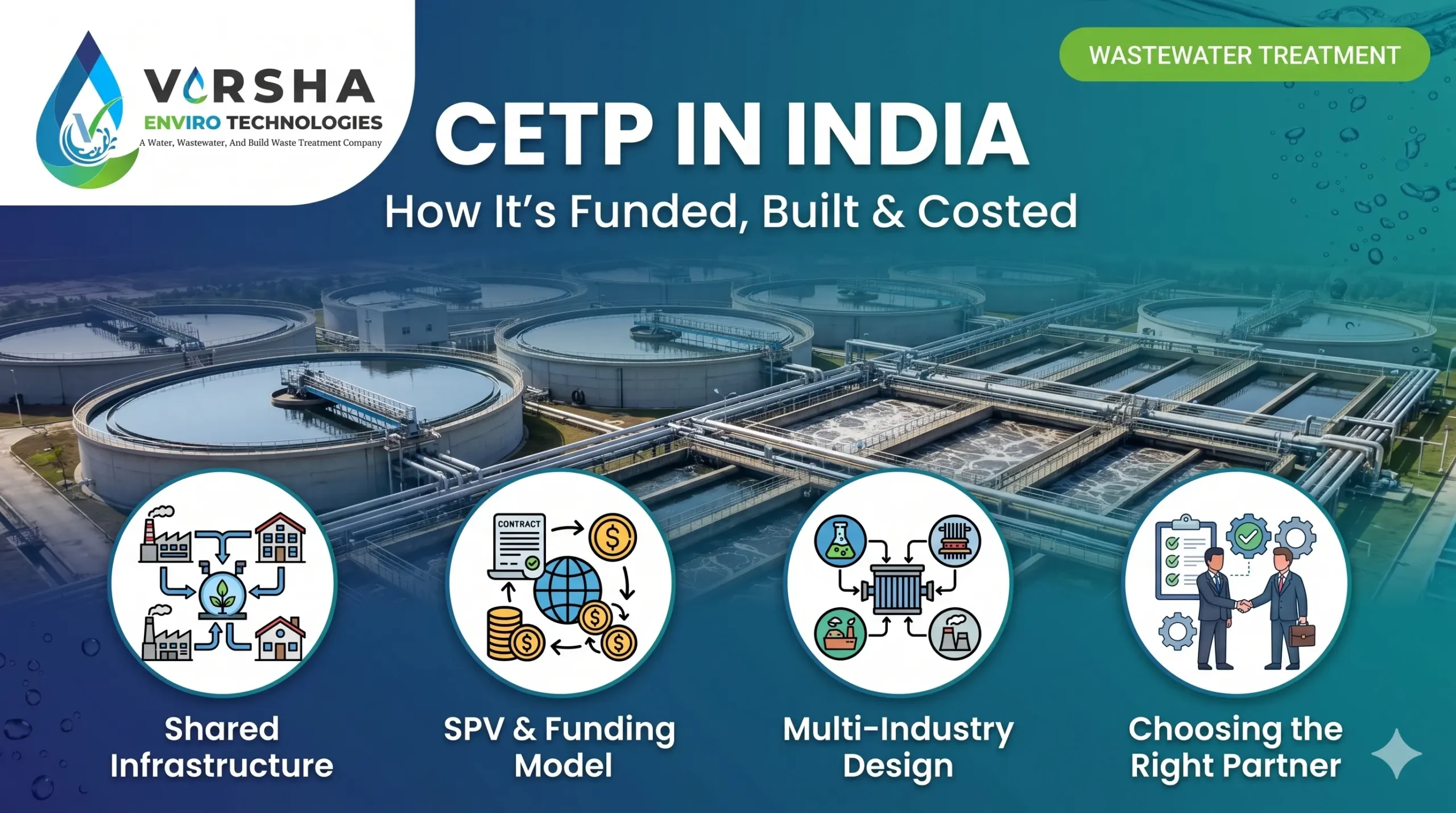
If you’re searching for “CETP plant manufacturers in India,” there’s an important clarification worth making upfront: a Common Effluent Treatment Plant is rarely something one company simply buys the way it would buy an STP or ETP for its own factory. CETPs are shared infrastructure serving an entire industrial cluster or estate — and understanding that structure is essential before evaluating any vendor or technology partner.
What Is a CETP, Really?
A CETP treats combined wastewater from multiple industrial units within a designated industrial estate or cluster, rather than effluent from a single facility. It exists because individual treatment plants are often financially out of reach for small and medium units — pooling treatment into shared infrastructure makes compliance affordable for everyone in the cluster.
CETPs are generally classified into two types:
- Homogeneous CETPs — serving industries producing similar effluent (e.g., a cluster of textile dyeing units)
- Heterogeneous CETPs — serving a mix of industries with widely different effluent types within the same estate
This classification matters because it directly affects treatment design complexity and cost.
Who Actually Sets Up a CETP?
In most cases, a CETP is established through one of these routes:
- State Industrial Development Corporation — provides land, infrastructure backing, and often co-funds the project
- Industrial association or member-unit consortium — forms a Special Purpose Vehicle (SPV) or company, with member units contributing toward capital and ongoing operational costs
- Government-supported scheme — many CETPs receive central/state subsidy support given their public environmental benefit
A technology or EPC partner is then brought in to design, build, and often operate the plant — this is where a company like Varsha Enviro fits in: as the engineering, equipment, and execution partner, not as a vendor selling a finished CETP “product.”
Real-World CETP Project Scale
To put project economics in perspective: a 1 MLD (1,000 KLD) CETP project — a realistic size for a mid-size industrial cluster — can involve capital costs in the range of several crore rupees, covering equalization tanks, aeration systems, clarifiers, sludge handling (filter press/dewatering), and control infrastructure. This is a materially different financial conversation than a single-unit ETP, which is why CETP planning typically starts with a feasibility and cost-sharing study among member units, not a simple vendor quote.
The CETP Treatment Process
A typical CETP design includes:
- Intake & screening — removing large solids/debris from combined effluent
- Equalization tank — critical for CETPs because flow and pollutant load fluctuate as different member units operate on different schedules
- Primary treatment — coagulation, flocculation, clarification
- Biological treatment — aerobic treatment (often MBBR-based) to reduce BOD/COD
- Secondary clarification — settling biomass, with partial recirculation to maintain treatment efficiency
- Sludge thickening & dewatering — via filter press, producing disposable solid sludge
- Tertiary/polishing stage — where required by discharge norms
Checklist: Evaluating a CETP Technology Partner
Since you’re not buying a packaged product, the evaluation criteria are different from choosing an STP/ETP vendor:
1. Experience with Multi-Industry Effluent Streams
Has the partner designed for clusters with mixed effluent types (textile + chemical + food, for example)? This is significantly more complex than single-industry effluent design.
2. Flexible, Scalable Design
Can the design accommodate new member units joining the estate over time without a full redesign?
3. Technology Stack Appropriateness
Does the proposed design match your cluster’s actual effluent — physico-chemical treatment, biological stage, tertiary polishing, and ZLD-readiness if your cluster may face stricter future norms?
4. Compliance & Documentation Support
Will the partner actively support the SPV/consortium’s Consent to Establish (CTE) and Consent to Operate (CTO) process with the State Pollution Control Board — not just supply equipment and leave compliance paperwork to the member units?
5. Post-Commissioning Operation Support
CETPs run continuously and serve multiple stakeholders — downtime affects every connected unit. Confirm AMC terms, operator training, and breakdown response time.
6. Transparent, Itemized Costing
A trustworthy partner separates equipment, civil work, electricals, and AMC costs — rather than a single bundled figure that’s difficult to evaluate against alternative proposals.
Red Flags in CETP Vendor Evaluation
- A partner who quotes design or pricing before reviewing effluent characterization data from member units
- No clear plan for handling future capacity expansion as the industrial estate grows
- No prior experience with multi-industry, heterogeneous effluent streams
- Vague or absent AMC/long-term support commitments
Why This Decision Matters Beyond Cost
A poorly designed or poorly maintained CETP doesn’t just create a compliance problem for one company — it creates exposure for every unit connected to the cluster. This is why CETP technology partner selection should weigh experience and long-term reliability far more heavily than the lowest quoted price.
Varsha Enviro’s CETP systems are designed for industrial clusters across Delhi NCR, Haryana, and Jaipur with scalable, multi-stage treatment (physico-chemical + biological + tertiary), backed by our repair and maintenance services for long-term operational reliability.
Frequently Asked Questions
Q: Is a CETP the same as an ETP?
A: No. An ETP treats effluent from a single facility. A CETP treats combined effluent from multiple industrial units sharing infrastructure within a cluster or estate — requiring more flexible, complex design.
Q: Who is responsible for CETP compliance — individual units or the cluster operator?
A: Generally, the CETP operator/SPV is responsible for final discharge compliance of the combined effluent, while individual units are typically required to pre-treat their effluent to agreed limits before discharging into the CETP.
Q: Can my company get involved in a CETP if one already exists near our facility?
A: Often yes — many existing CETPs accept new member units (subject to capacity availability and effluent compatibility), which is usually far more cost-effective than building a standalone ETP.
Q: How long does CETP commissioning typically take?
A: This varies significantly with capacity and the number of connected units, but proper commissioning always includes a trial run period validating performance under real, combined effluent conditions — not just design-stage projections.
Final Thoughts
Choosing a CETP technology partner is fundamentally different from buying an STP or ETP — it’s a long-term infrastructure decision affecting an entire industrial cluster. Prioritize partners with genuine multi-industry effluent experience, transparent costing, and strong compliance support over the lowest initial quote.
Planning a CETP for your industrial estate, or considering joining an existing one? Request a consultation with our team for a design and feasibility assessment.